
But by the third day, I had settled into the rhythm of life in the studio. We ate breakfast of bread, cheese, and tea and then Khushnud and I spent the morning at the pottery wheels, throwing new pieces, decorating, and trimming whatever had dried enough to handle.
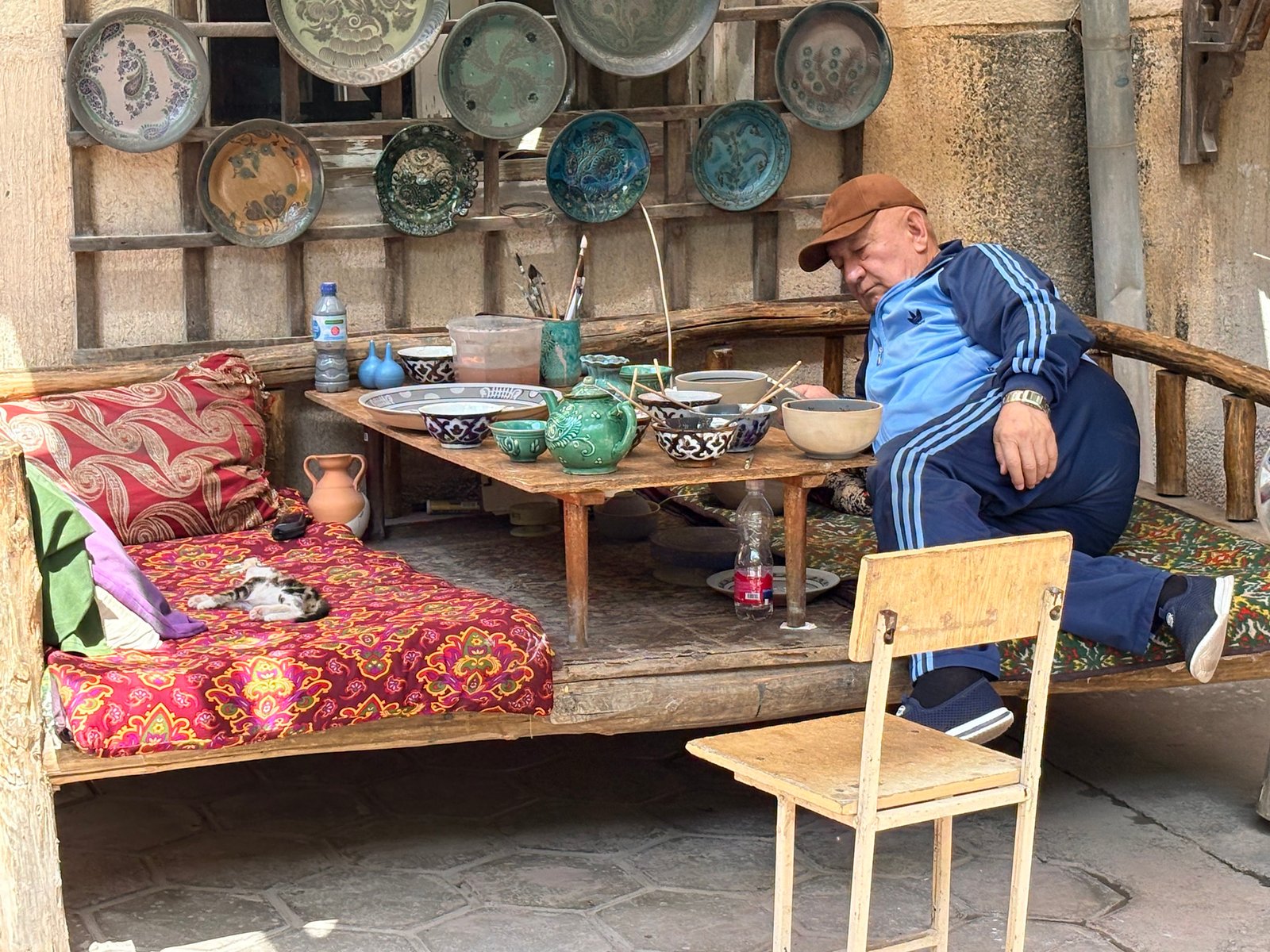
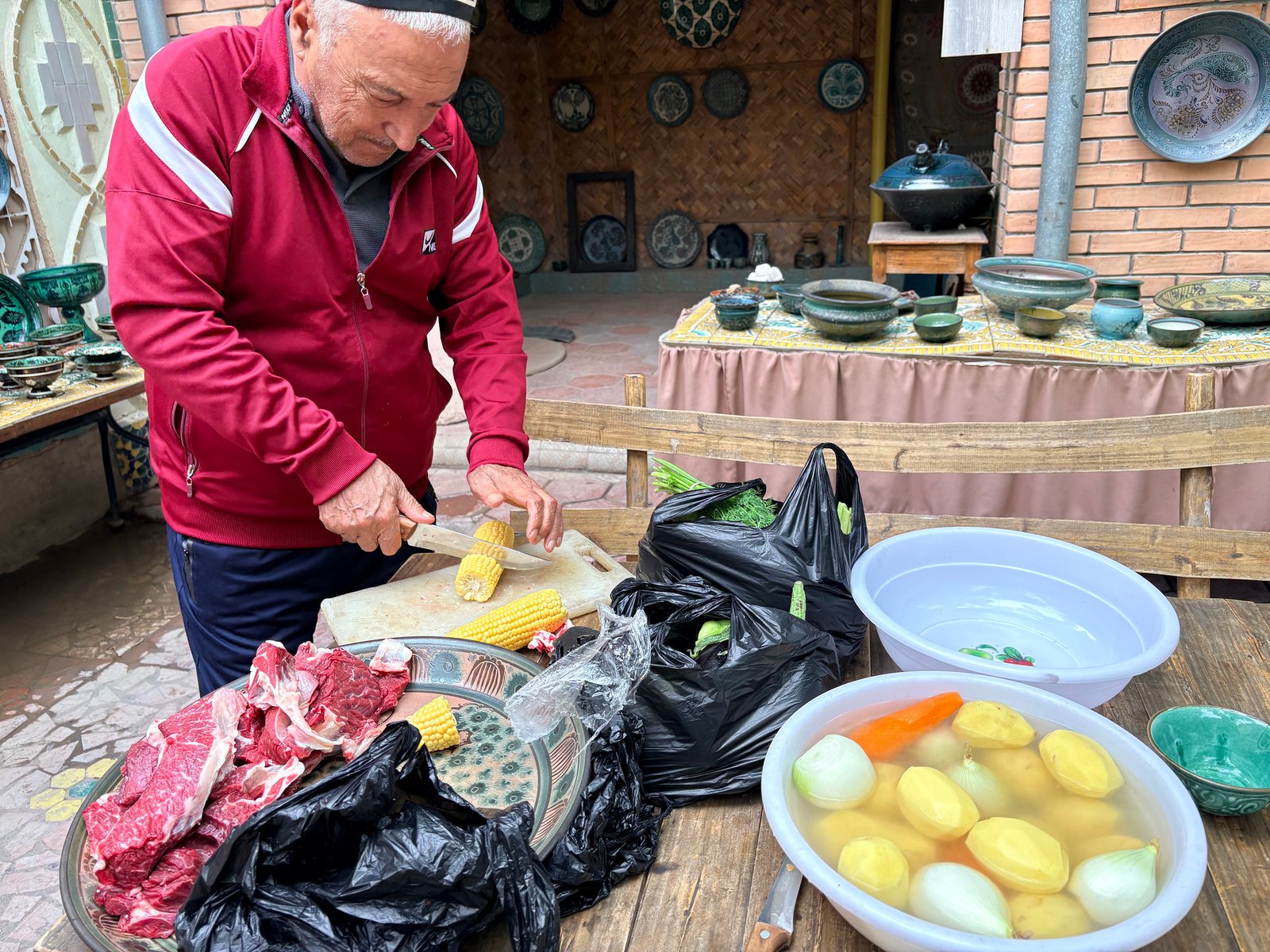
Before long, it was lunchtime. Lunch was often treated as a social hour, when family members, neighbors, or Master’s friends dropped by, often bringing groceries and cooking large meals for everyone. It wasn't unusual to find an elderly man napping on the tapchan in early afternoon. He was always someone’s uncle or Master’s childhood friend, and soon enough he would wake up refreshed and start chopping vegetables, skewering meats, or cooking plov in a kazan iron pot with a portable gas burner.
We ate, talked, relaxed for an hour, and then returned to work, at the wheel or painting ready pieces.
Around two o'clock, when school ended, Edik would arrive. At thirteen, he was the youngest apprentice in the studio and had been studying pottery for about a year. Even so, his skill and dedication were already putting me to shame.
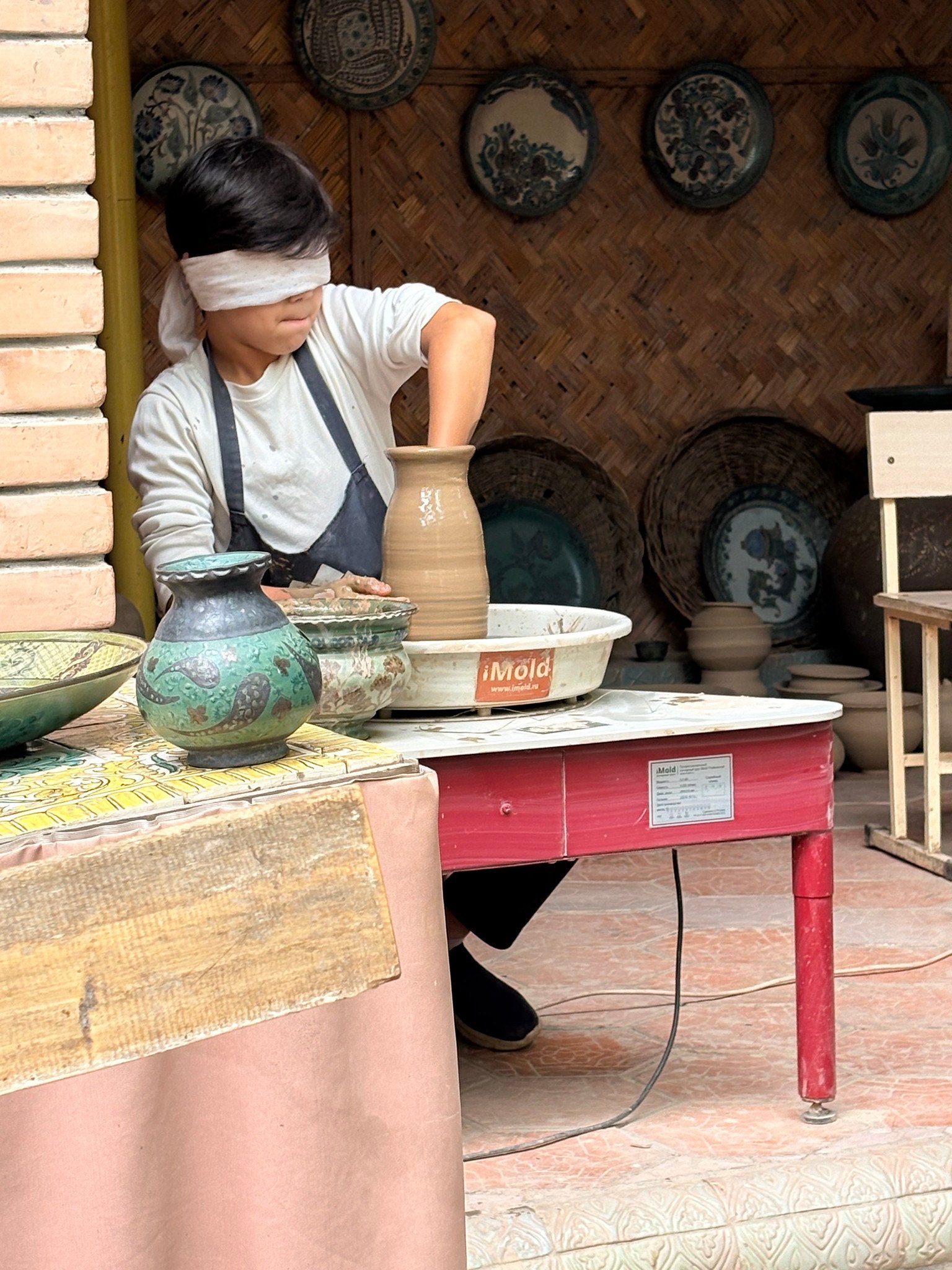
On my second day in the studio, I watched him perform a “Master Class” for a group of tourists. He threw a tall, perfectly shaped vase at the wheel and decorated the rim… while blindfolded.
Hamaum, the senior apprentice in his late twenties and the Master's right-hand man, narrated the demonstration.
"Long ago," he told the visitors, "A great Rishton potter lost his eyesight but still had to support his family. He learned to shape clay without using his eyes, only his heart. The forms he created could never be recreated by artists who relied on sight. That is why all of us learn to throw blindfolded."
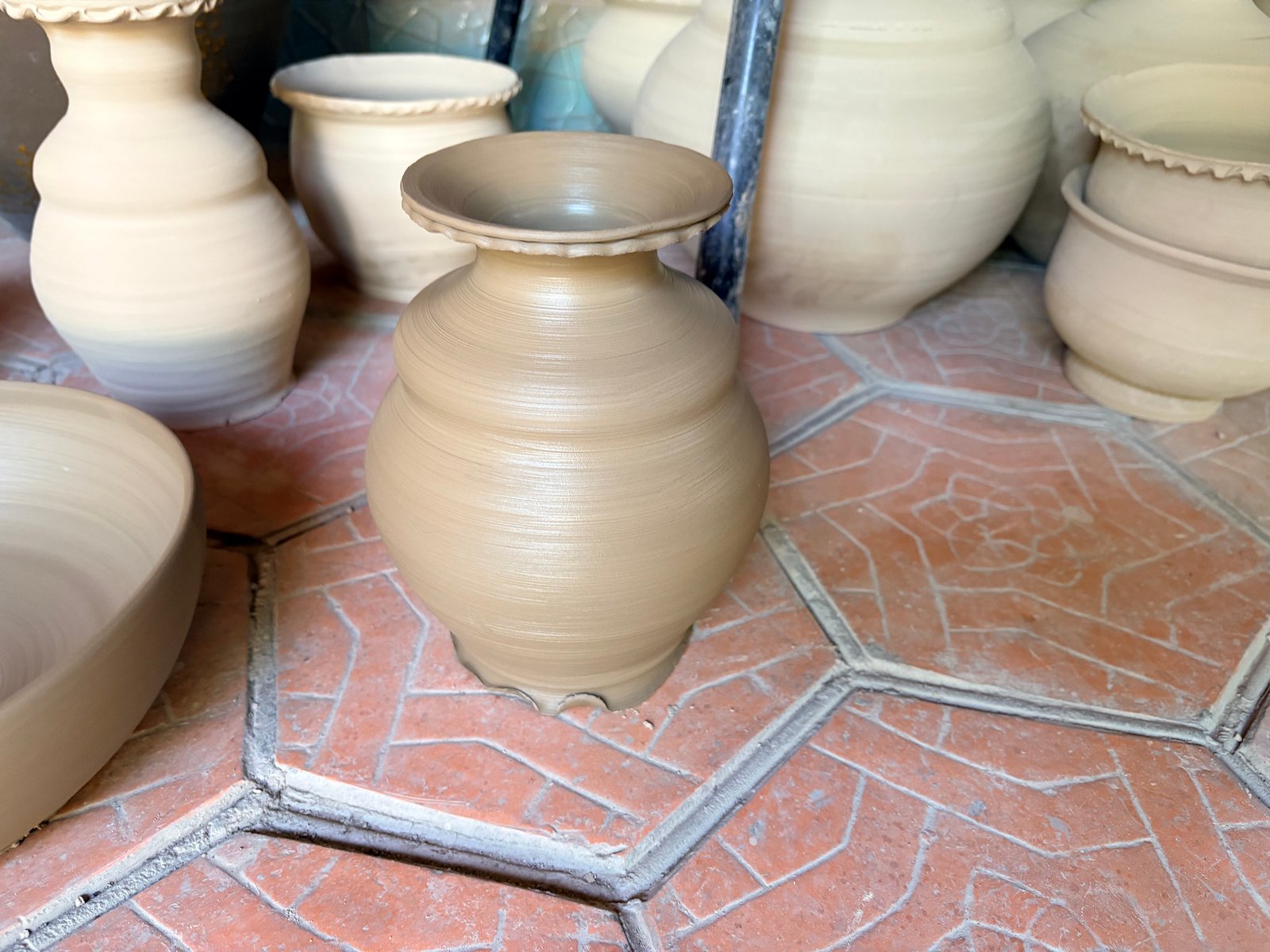
Tour groups arrived throughout the day, along with independent travelers wandering in, and someone would always leave their work to attend to the guests. Guests were shown around, explained how traditional pottery is made, shown a Master Class, and offered a pot of tea, in a show of Uzbek hospitality. I heard the same stories about history of Rishton pottery and meanings behind traditional decoration patterns repeated over and over, as tourists admired different plates, bowls, and vases. Many left with a carefully wrapped purchase.
Coming from a capitalist culture, I assumed selling pottery was the entire point. Every time someone bought a plate or a tea set, I silently celebrated. But I noticed that the other students didn’t really care if the tourists bought something or not.
“It’s not about the sale,” Khamidulo said in his typical philosophical fashion, “We are here to teach our ancient pottery traditions to both locals and foreigners. Even if they don’t buy anything now, we are planting a seed of appreciation and love for our craft.”
While I admired his stance, it was a life view born out of privilege. The Master was one of Uzbekistan’s best-known ceramist artists and there was never any lack of interest in his craft. There was no need to fret over sales numbers or hassle the tourists to make a sale. Lesser-known potters in Rishton did not enjoy this luxury, their livelihoods depending heavily on their ability to sell their work.
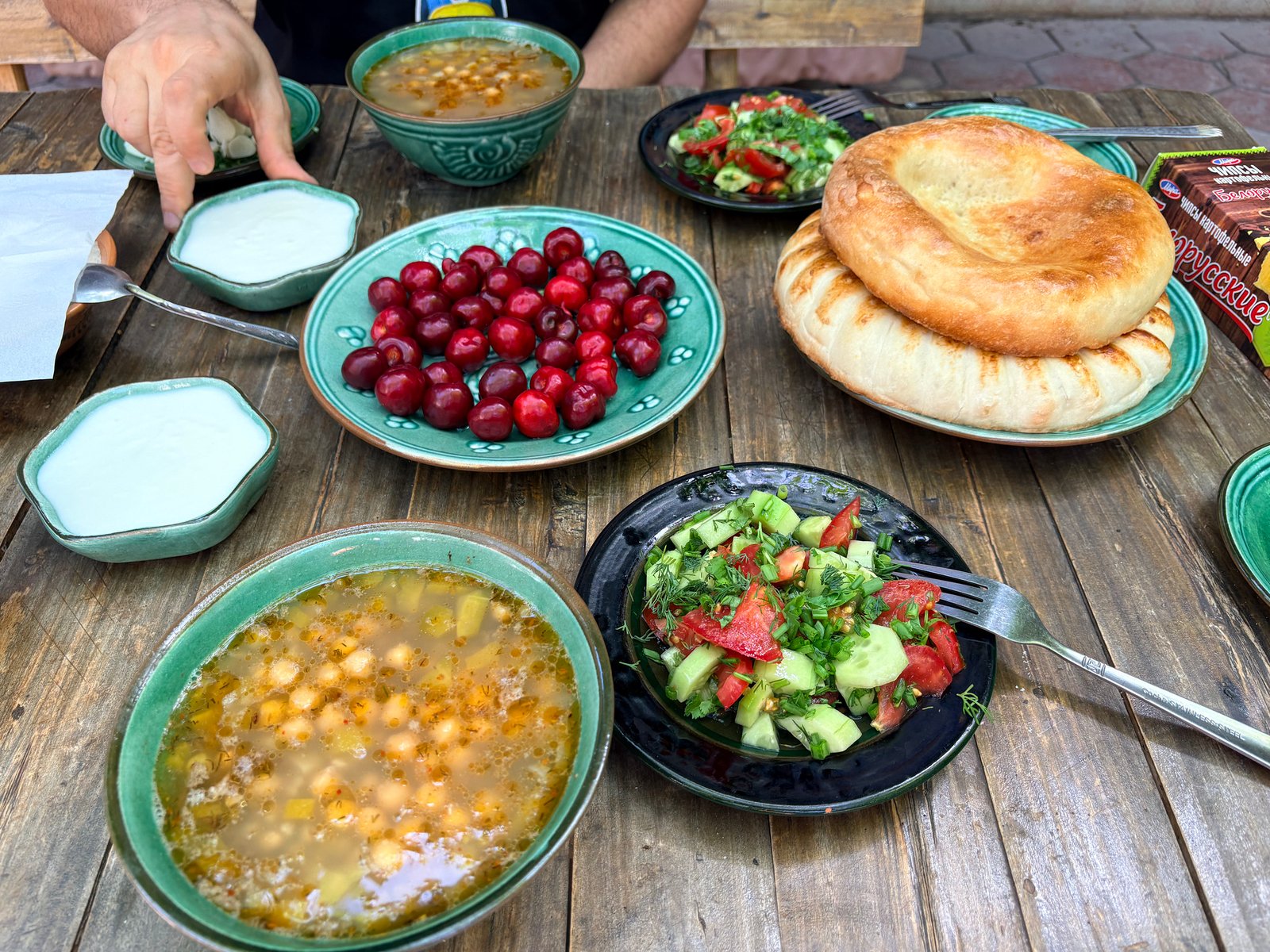
As the sun set, the work in the studio did not stop. Grandpa Akram served dinner, usually soup or stew, followed by enormous platters of rice, buckwheat, chickpeas, potatoes, or pasta alongside grilled vegetables and meat.
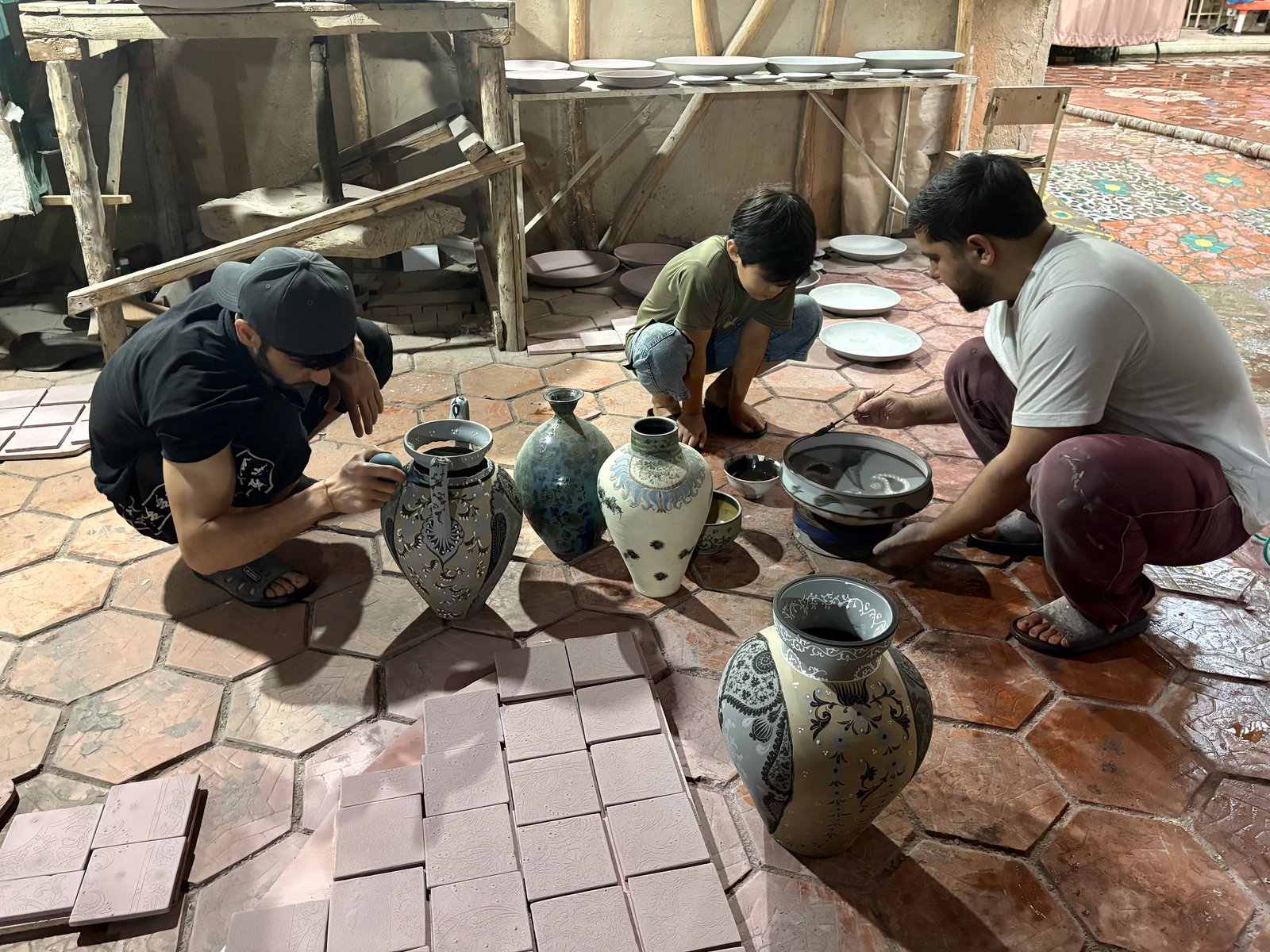
We ate and went right back to work. Hamaum painted decorative tiles, a pre-order from a local business. Khamidulo sat cross-legged on the tapchan beneath a hanging lamp, covering plates with intricate designs. Khushnud returned to the wheel to throw more pottery. Edik was eventually sent home before it got dark, though he always begged for just a few more minutes at the wheel.
"When do you rest?" I asked one evening. "Do you have days off?"
The question puzzled everyone.
“Days off?” Khushnud laughed. “It’s not like this is a warehouse job!”
Earlier he had told me about spending months working in a warehouse in Russia, where supervisors and coworkers treated him terribly.
“We rest when we want,” Khamidulo said, “Whenever I don’t feel inspired to create is when I rest.”
From what I saw, inspiration never left any of them.
On my third day, I was working at the wheel, my hands up to my elbows in clay, when Khushnud nodded toward a newly arrived group of tourists.
"These guests only speak English," he said. "Can you help?"
The Master, who spoke Russian, English, and Japanese fluently, was still away at a ceramics conference in Bishkek. None of the apprentices had a good grasp of English.
"Sure," I said, wiping the clay from my hands.
I expected Khushnud to follow me, but instead he sat down at the next wheel and started centering a lump of clay.
"Aren't you coming?" I asked. "I'll translate."
He smiled, "No need. You know all the stories. You can tell them yourself."
I walked over to the visitors, hoping they couldn't tell how nervous I was.
They were Americans, and they were so relieved that someone in the studio spoke English they never questioned my credentials. I launched into the tour, surprised by how quickly and easily the words poured out of me.
"The clay in Rishton is unique," I began. "It's pure, it’s alive. It fires like no other clay in the world. It comes from the ground beneath our feet, and once you leave Rishton, you won't find this clay anywhere else."
I picked up two small plates and struck them together. A clear, high-pitched ring echoed through the courtyard.
"Hear that? No other clay rings like this."
I paused for effect.
"There's an old legend. The clay comes from the very ground where generations of people have been buried. If the person resting beneath the earth lived a good life, the clay will ring. If they were a bad person, the clay will remain silent."
I smiled, "And since everyone in Rishton is a good person...the clay always rings."
The group laughed.
Next, I explained the subtle beauty of ishkor glaze.
“Have you noticed the difference between traditional Rishton glaze and the usual shiny glaze? Ishkor is a natural glaze made from local materials, processed traditionally. Do you see how it draws the eye? Shiny chemical glazes reflect back at you, while ishkor glaze glows from within, highlights the decorative patterns, gives depth to each piece. Ishkor glaze can be clear or have a yellowish, greenish, or bluish tint, depending on what natural plants have been added to it.”
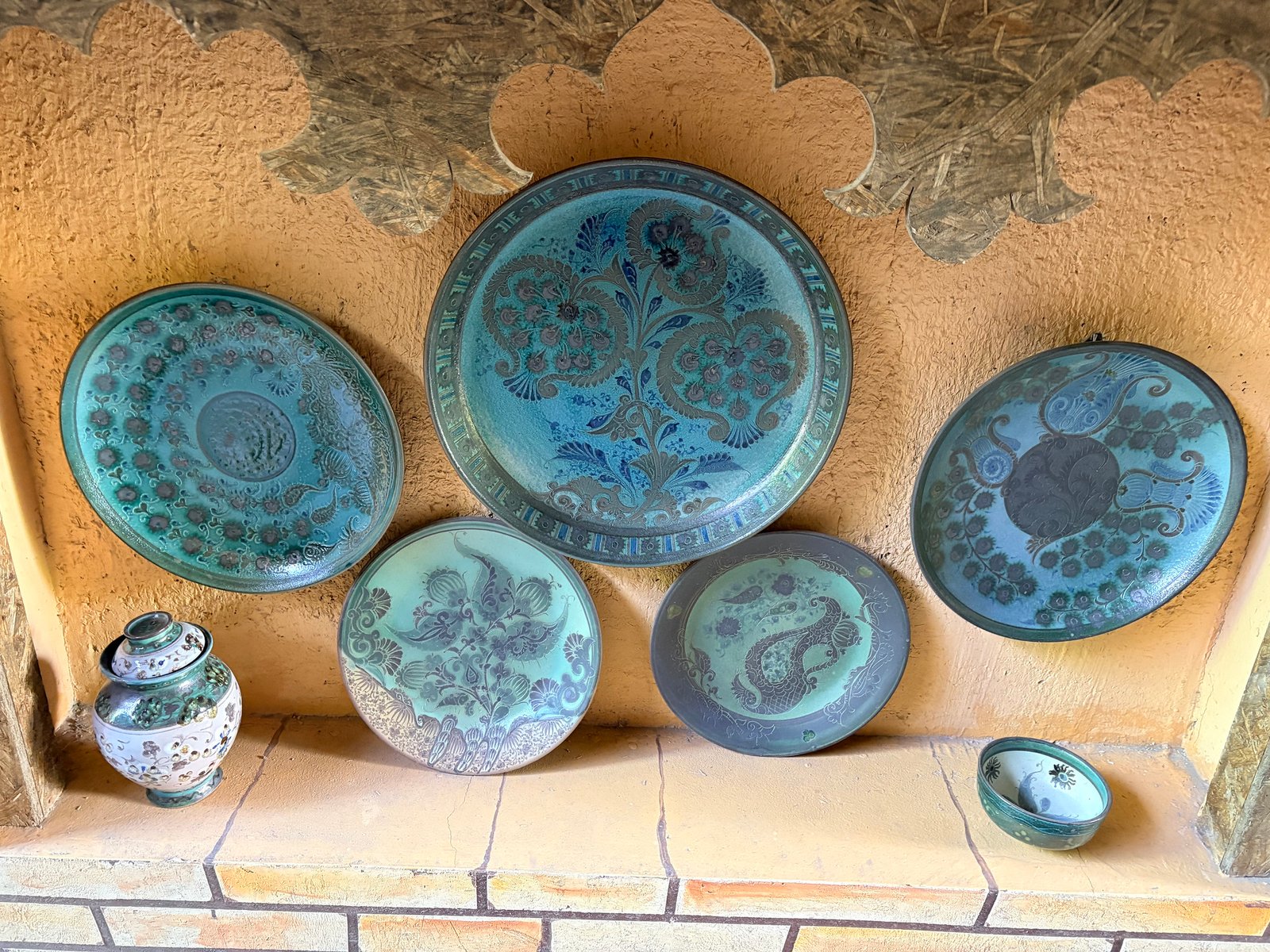
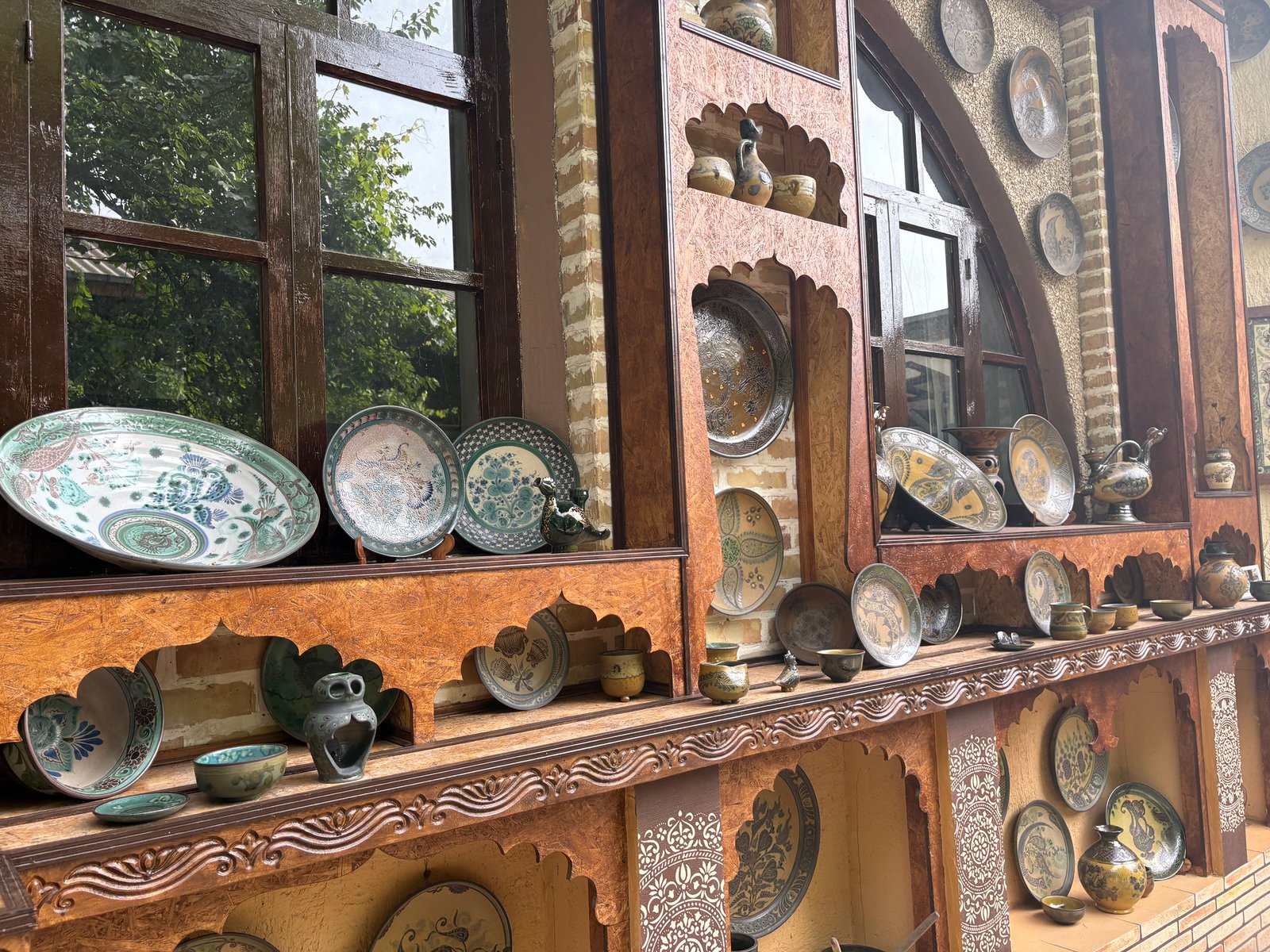
As we walked through the courtyard, I pointed out the traditional motifs decorating the pottery and explained their symbolism. Images of a pepper used as protection from evil, a pomegranate to bring forth abundance in wealth and in fertility, and pretty combs shaped like tulips to celebrate feminine beauty.
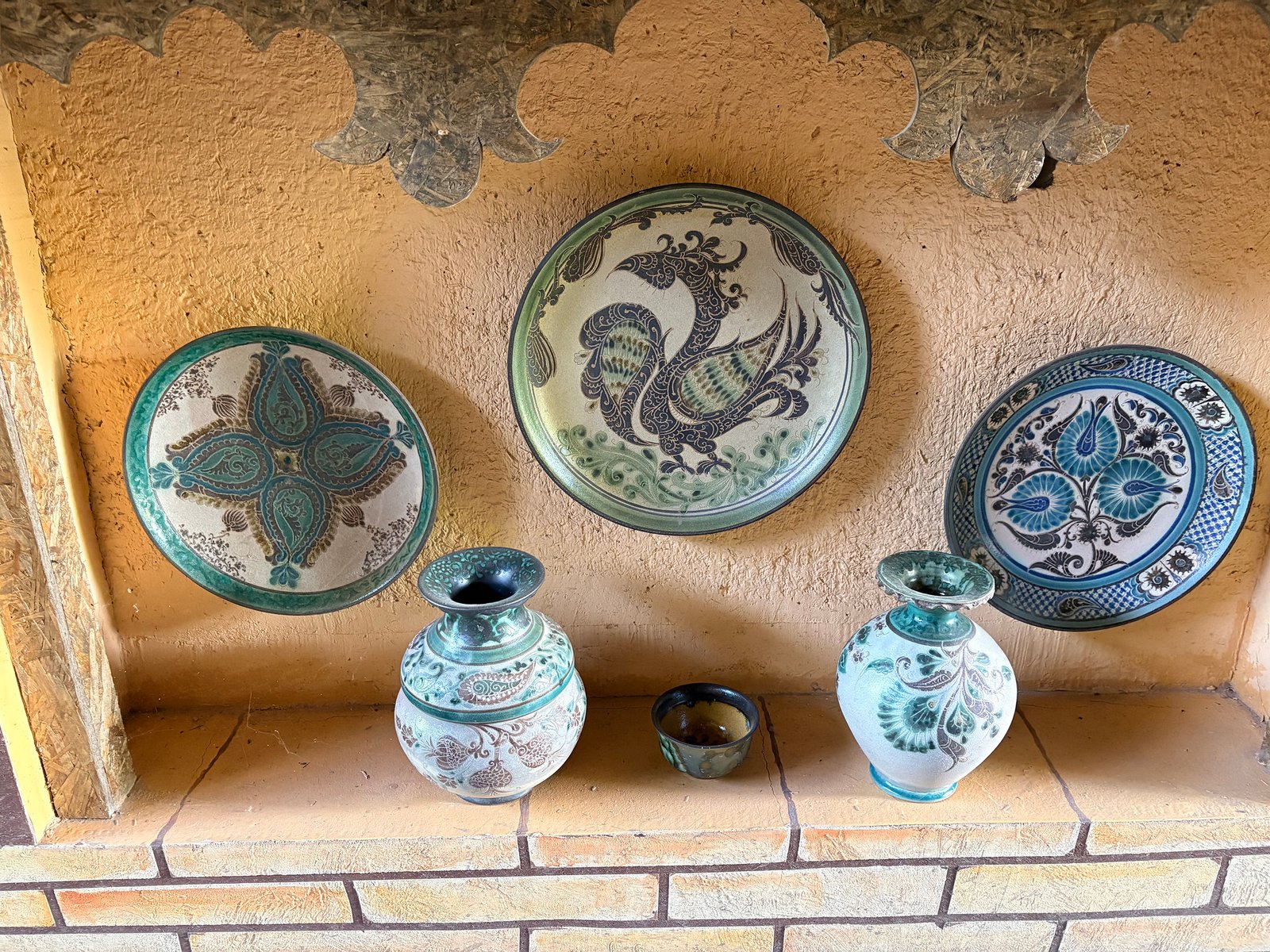
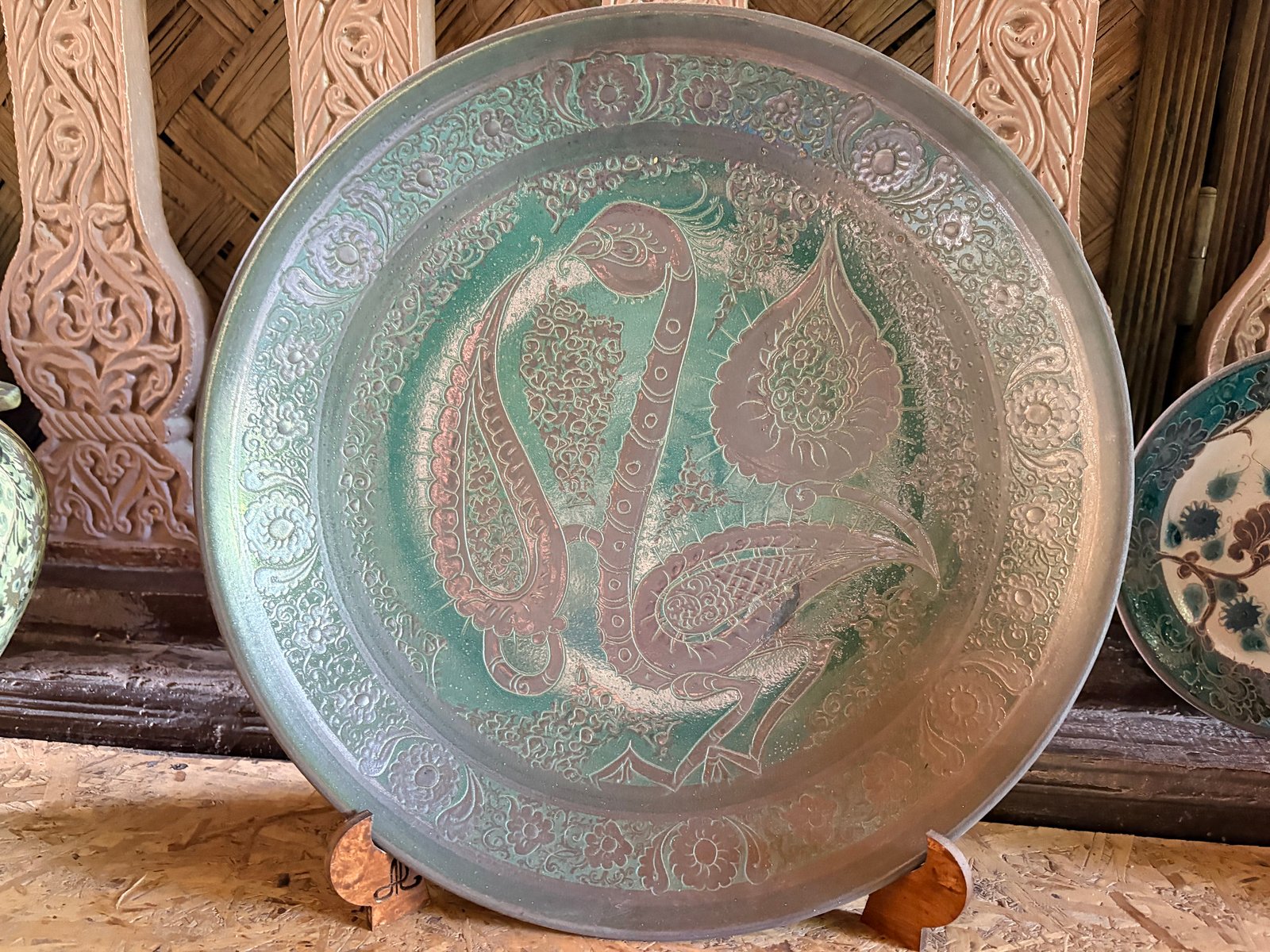
Then I stopped in front of a plates, each decorated with a strange-looking bird.
"And these mythical beasts," I said, "are Birds of Destiny. According to local tradition, everyone has a bird of destiny above their head. Only you know what your own bird looks like, so artists paint them in every imaginable shape and color. As you walk around the studio, you'll probably see birds you think are odd or even ugly. That's perfectly fine. It just means they aren't your bird."
"But eventually you'll come across one you can't stop looking at. That means you found your bird. It belongs to you.”
I let the tourists wander around the studio to search for their “bird”. Most came back with items to purchase.
Proud of myself, I hurried across the courtyard to find Victor, who was sitting in the corner doing his daily Spanish lessons. I was boasting how I was teaching tourists about Rishton pottery, when another group wandered in.
They spoke neither Russian nor English. Only Spanish. And now it was Victor's turn to shine. I led the tour in English while he translated into Spanish, delighted to have a chance to chat with native speakers.
Before long, another English-speaking group arrived, and Edik gave me a nod. He was ready for the master class. I tied the blindfold over his eyes. Without hesitation, he centered the lump of clay and began pulling its walls upward with calm, practiced movements.
"Long ago," I began, "a great Rishton potter lost his eyesight..."
The group sat, mesmerized, as the wheel spun beneath Edik's hands. Vases decorated with peppers and plates with strange mythical birds glittered from the walls. I remembered my first day when I walked into this courtyard, just wanting to learn. Now I wanted to participate, to preserve, to teach. I wanted to stay.