
I was chatting with my cousin, who lives in Frankfurt, Germany, and telling her all about our 36-hour trip to Munich just to attend the opening of Oktoberfest.
“Have you ever been?” I asked her.
“Oh no!” she exclaimed. “We are not big drinkers at all!”
“Neither are we!” I laughed.
There was a pause. I knew the question she wanted to ask me: Why did you interrupt your Austrian trip to take a bus from Innsbruck to Munich for Oktoberfest if you don’t drink?
“We did it for the culture!” I joked. But it was true.
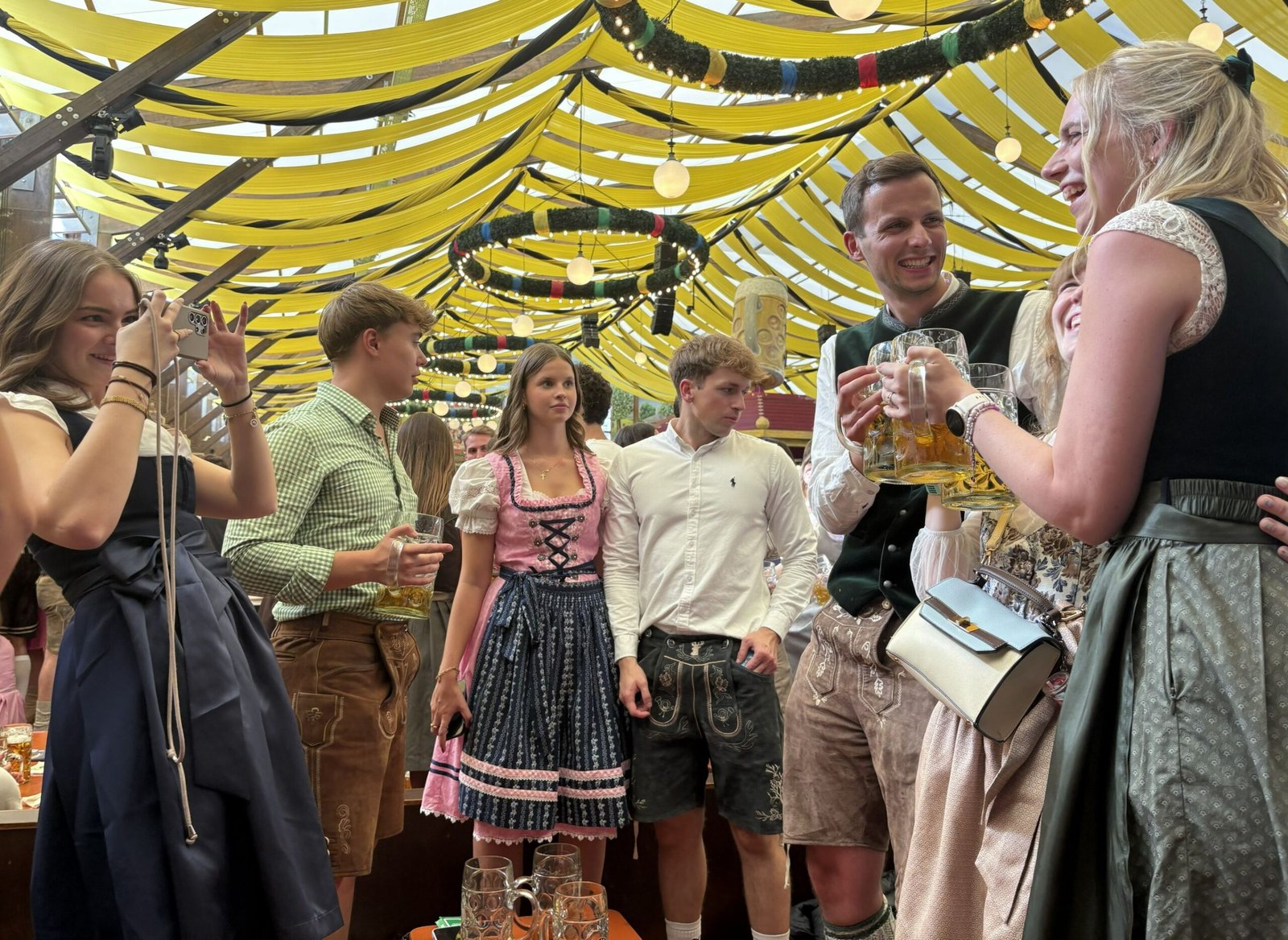
Oktoberfest in Munich is the largest folk festival in the world, and while it serves more beer than any other festival, around 7 million liters in a typical year, there is so much more to it. It’s a cultural event where, besides local beer, traditional food, and live brass bands playing everything from German folk songs to American pop hits, locals show up dressed in traditional Bavarian clothing, lederhosen for men and dirndls for women, ready to party. There is dancing on benches, swinging beer mugs, singing songs, and toasting all day long.
I’ve been to Germany briefly a few times, once for a week more than 20 years ago and more recently for a day during a Frankfurt stopover, and both times Germans struck me as reserved and serious people. It was time to see them cut loose.
I thought we were going to see the festival and just stroll around the food stalls, amusement rides, and enormous beer tents, listening to music and taking plenty of pictures and videos. Victor had a different idea. We were going to participate.
“We should go early to get a spot in one of the big tents,” he said. “And we really should order a beer each, so we can toast with everyone.”
I’ve never drunk more than a few sips of beer, and these were one-liter mugs of strong Oktoberfest beer, around 6.3% ABV.
“What do you think about renting Bavarian clothes?” he asked. “I’ll reserve lederhosen and a dirndl online just in case.”
Meanwhile, I had my own reservations. Was it OK for a non-German to wear traditional clothing? Were we going to look silly and out of place? And finally... was it a good idea for a lightweight like me to drink liters of beer while wearing rented clothes?
Only one way to find out.
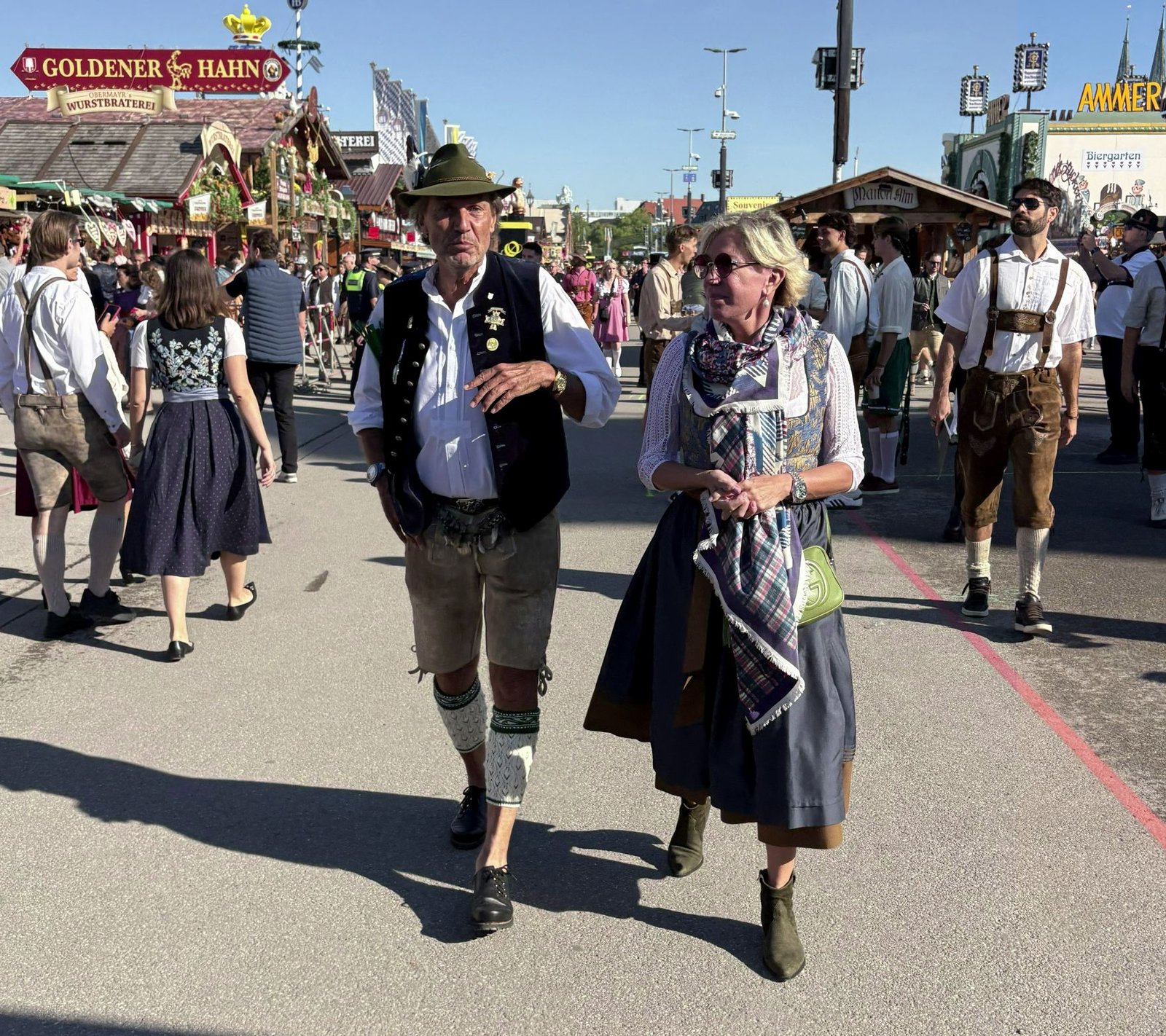
Our first morning in Munich, we woke up at 6:30 am, grabbed a quick breakfast of coffee and pastries at a cafe, and took the train to Theresienwiese. This is a large open field near Munich’s historic center, whose name translates as “Therese’s Meadow,” in honor of the marriage of Crown Prince Ludwig and Princess Therese, which was celebrated there in 1810. The locals enjoyed the celebrations so much that they opted to continue them year after year, eventually transforming the event into an annual festival now known around the world as Oktoberfest.
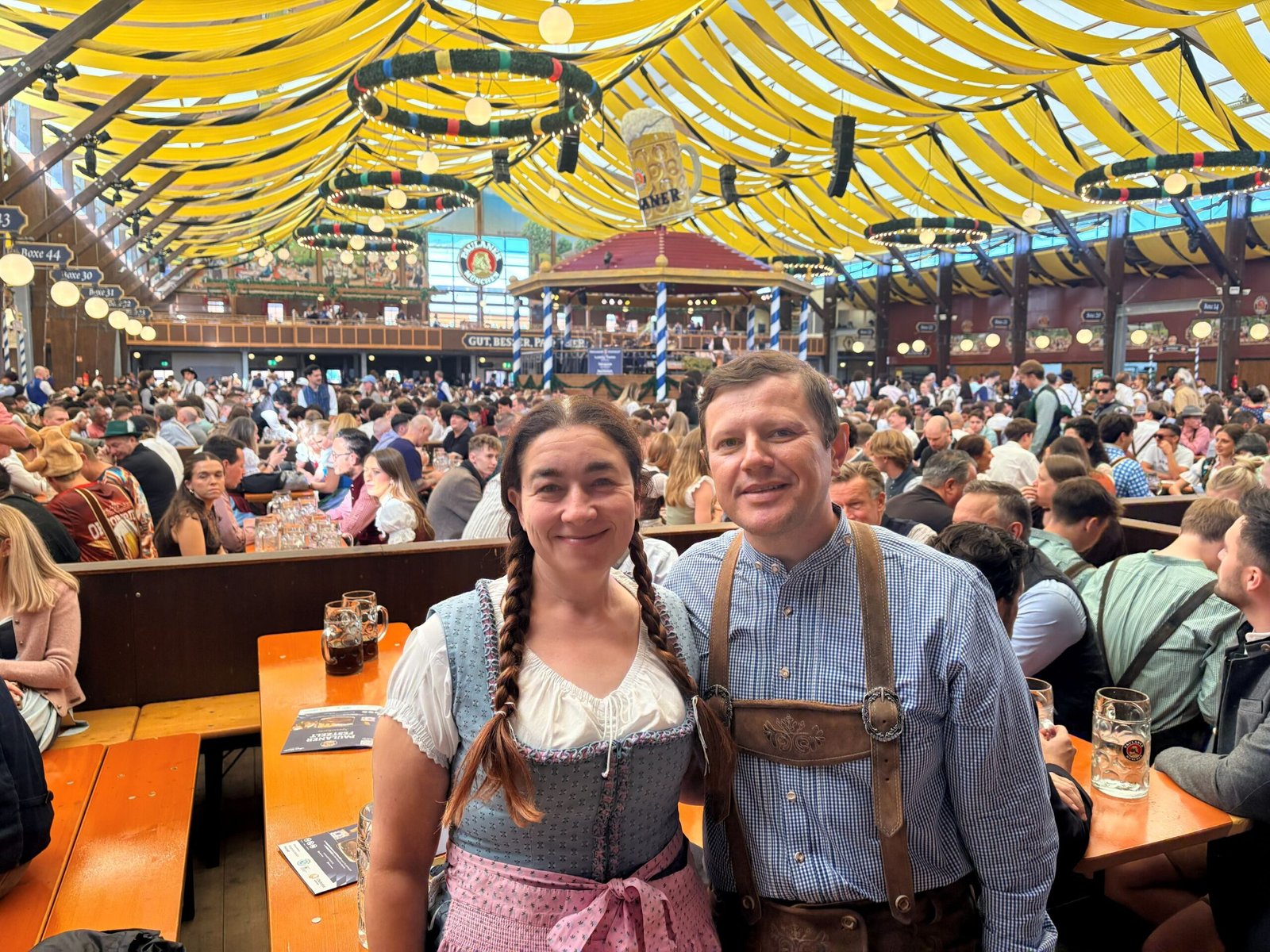
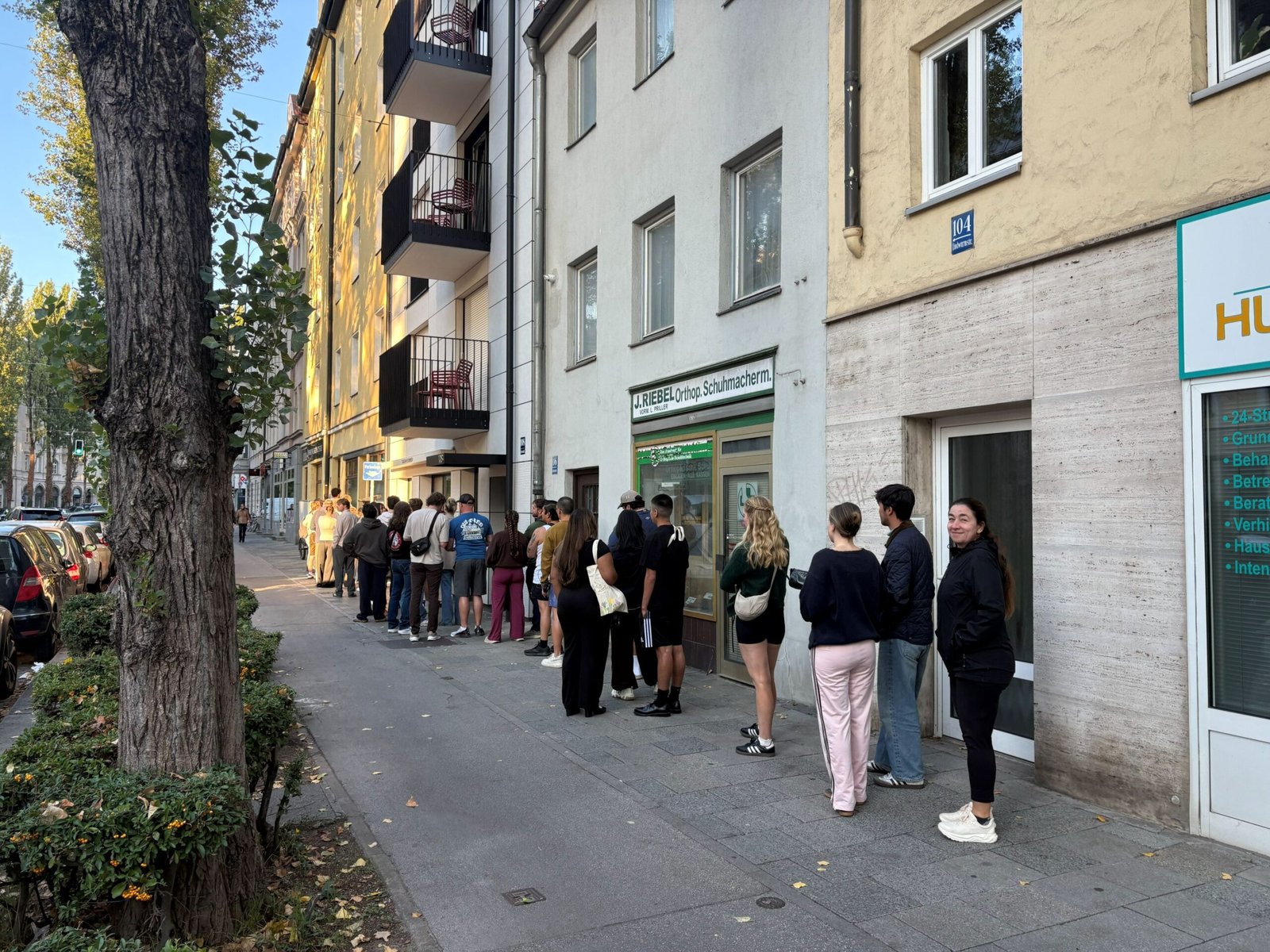
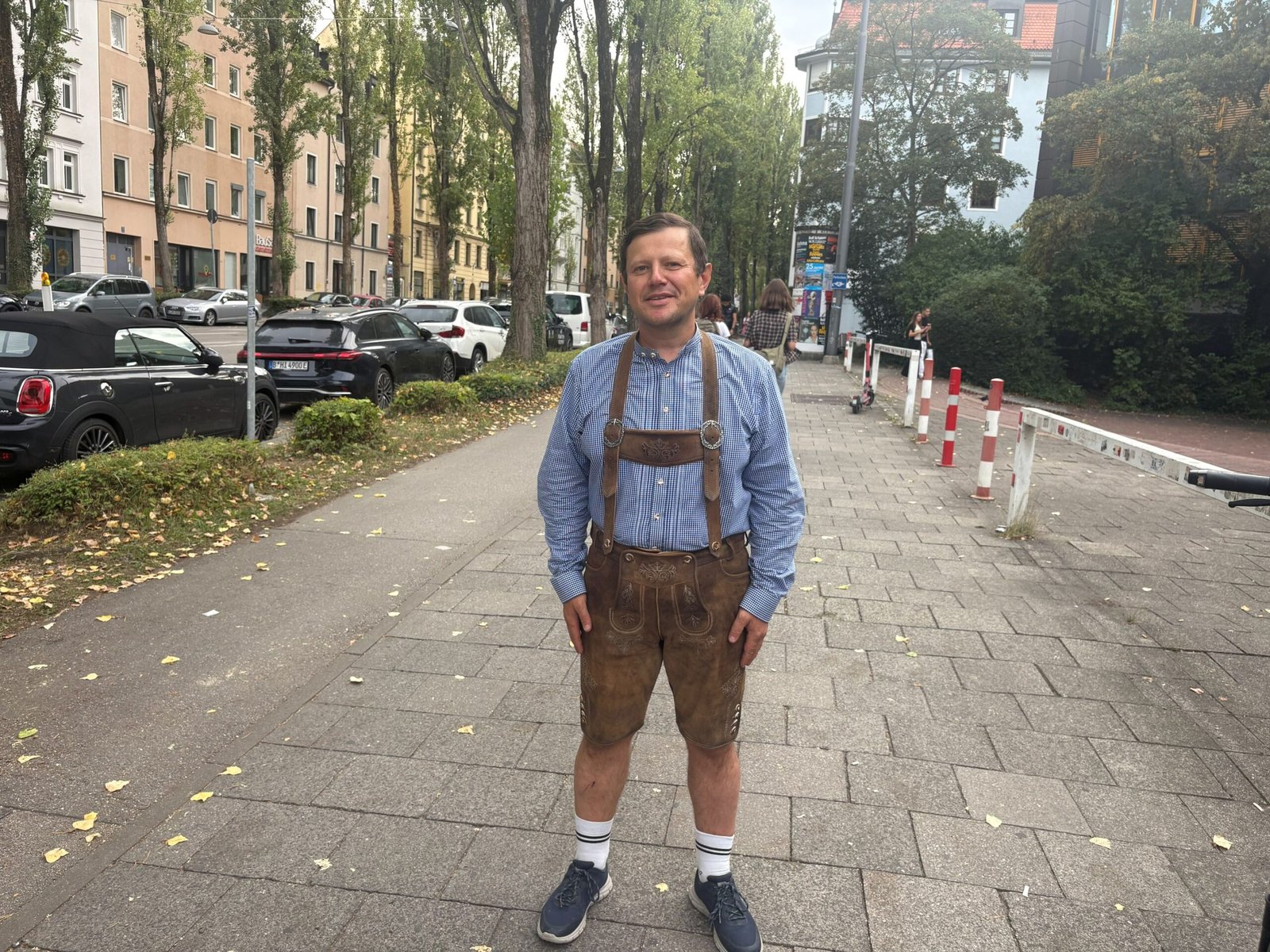
The clothing store was around a ten-minute walk from the fairgrounds and opened at 7:30 am. We were a bit dismayed when we arrived exactly on time to find a giant line of people stretching down the street, all waiting to rent their costumes. But the line moved surprisingly quickly, and within 20 minutes, we were inside the store trying on our clothes. Victor picked the color of his checkered shirt, jammed himself into a pair of leather shorts, buckled the suspenders over his shoulders, and declared that he was good to go.
I, in the meantime, was in a bit of trouble. A medium size in the US is not a medium in Germany, as I quickly learned while trying to fit into a tiny white blouse and then close the bodice over it. After a few exchanges, I finally got a dirndl big enough to breathe comfortably. At this point, I didn’t even care to be picky about the colors of the dress, I was just thrilled to have something that fit.
As we were making our way to Oktoberfest, we got caught up in a large crowd of people. Everyone around us seemed to be Asian. A lot of young adults and a few older people with kids were all walking briskly in the same direction.
“Wow... That’s a lot of tourists going to Oktoberfest.” Victor said and I shrugged. The more, the merrier. At least it would be easier to find where we are going by just following the crowd. And follow the crowd we did, right into a large building. From outside it looked like it might be one of those pedestrian walkways, a bridge across a busy intersection. So, undeterred, we walked upstairs with everyone.
Meanwhile, Victor was starting to look gloomier and gloomier. “I don’t see a single German in this crowd,” he murmured, “I thought this would be a cultural experience, but it’s been overrun with tourists!”
Upstairs, there was no sign on a pedestrian bridge. People started spreading out across floors, walking down large hallways.
“Victor.” I said, staring at a bulletin board on a wall, “This is a Chinese language school.”
We looked around. At a closer look, the young people were clearly teenagers and the rest of adults were here to drop off their kids. We somehow managed to walk into a school on our way to Oktoberfest. Laughing at our own stupidity, we ran out and continued down the street.
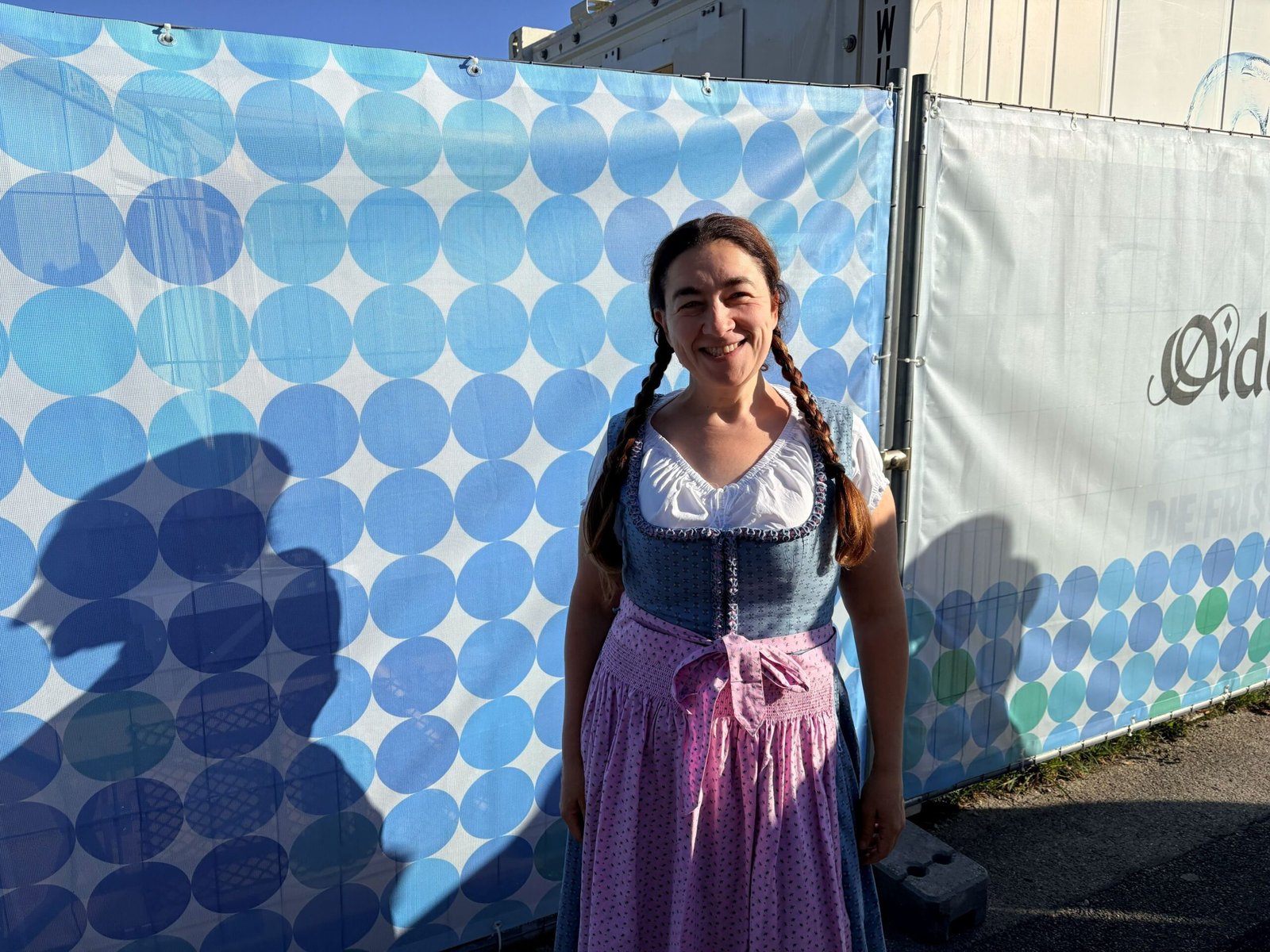
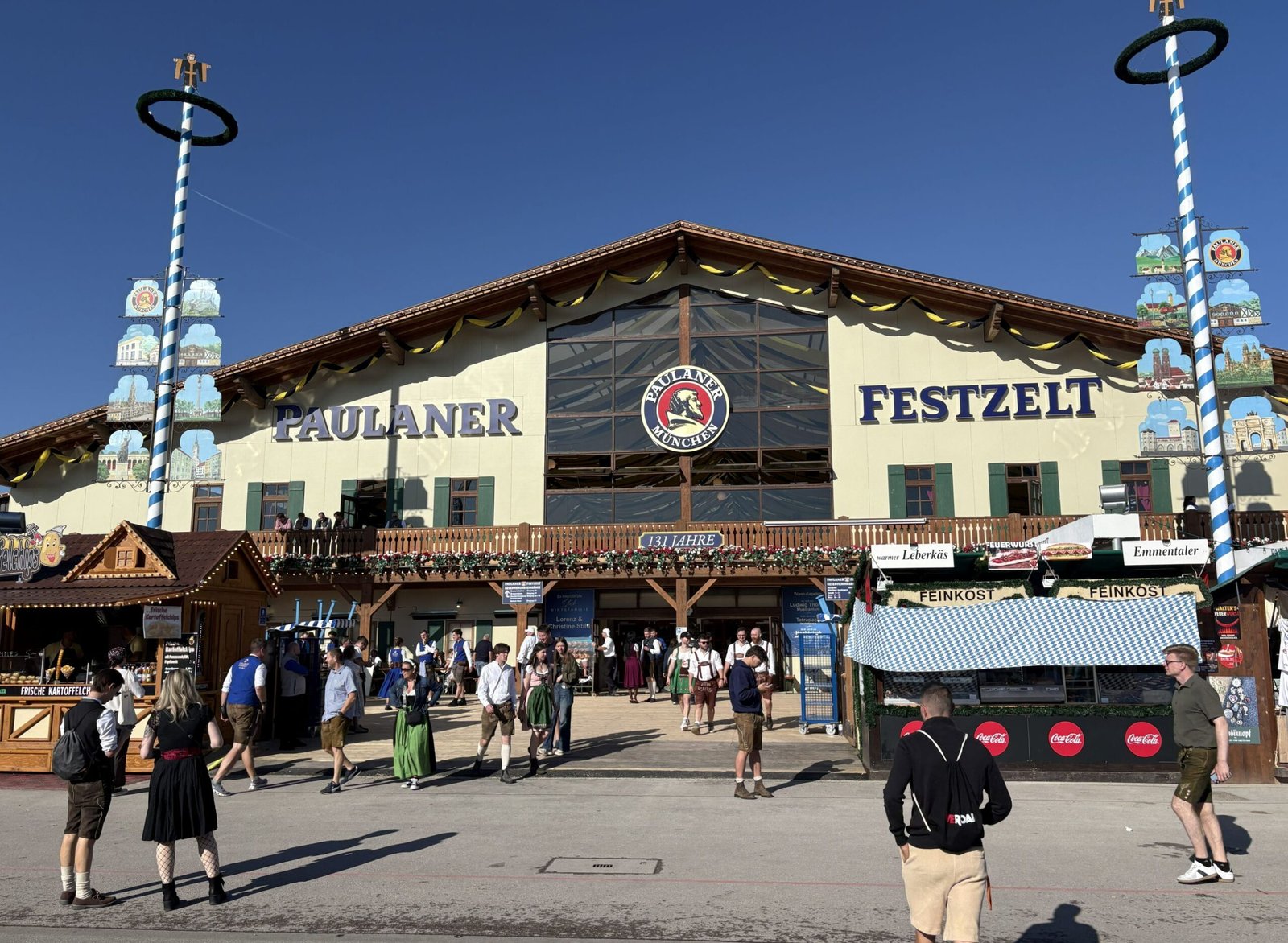
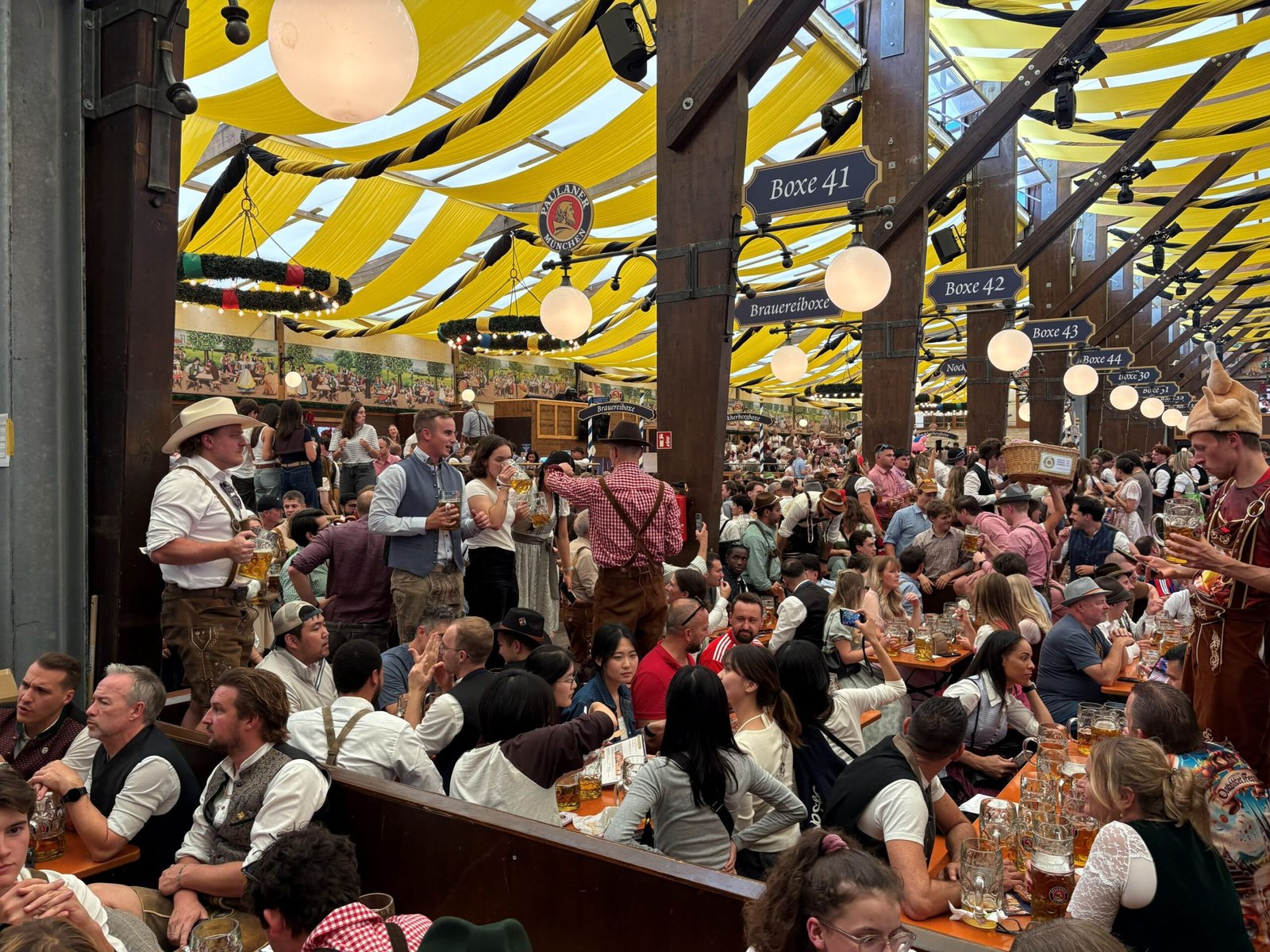
Soon enough we found a new crowds of people to join, this time all wearing lederhosen and dirndls. We made our way to the entrance and found a long line looping around the fence. The gates opened just as we took our place at the end, and the line started moving very quickly. Within minutes, we were inside the fairgrounds, walking among food stalls, large beer tents, and carnival rides. We decided to try to get a table at one of the biggest tents, the Paulaner, and quickly made our way inside. We quickly claimed a first available table, and within twenty minutes, all the empty tables were gone. Two young German couples asked to join us, later followed by three friends, and very quickly our table was full as well.
What do you do when it’s 9:30 am and you are in a beer tent with hundreds of people ready to party? Well, you start out by ordering lemonade because it’s opening day of Oktoberfest and beer isn’t served until noon. By tradition, at noon, Munich’s mayor taps the first keg in the Schottenhamel Festhalle Tent and shouts “O’zapft is!” (“It’s tapped!”), officially opening Oktoberfest. Once that happened, there was a parade of musicians through our tent, and some local celebrity tapped the first keg.
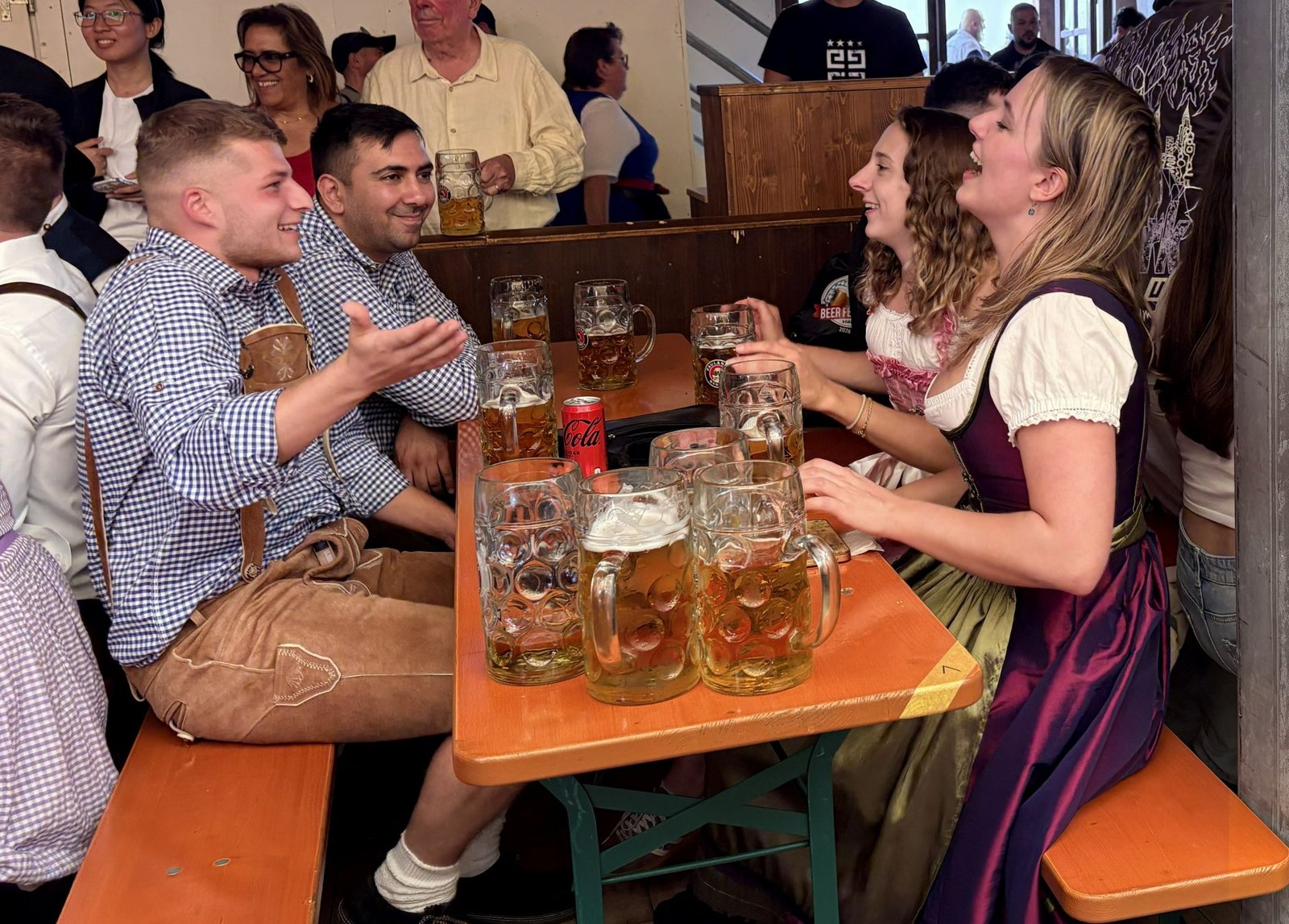
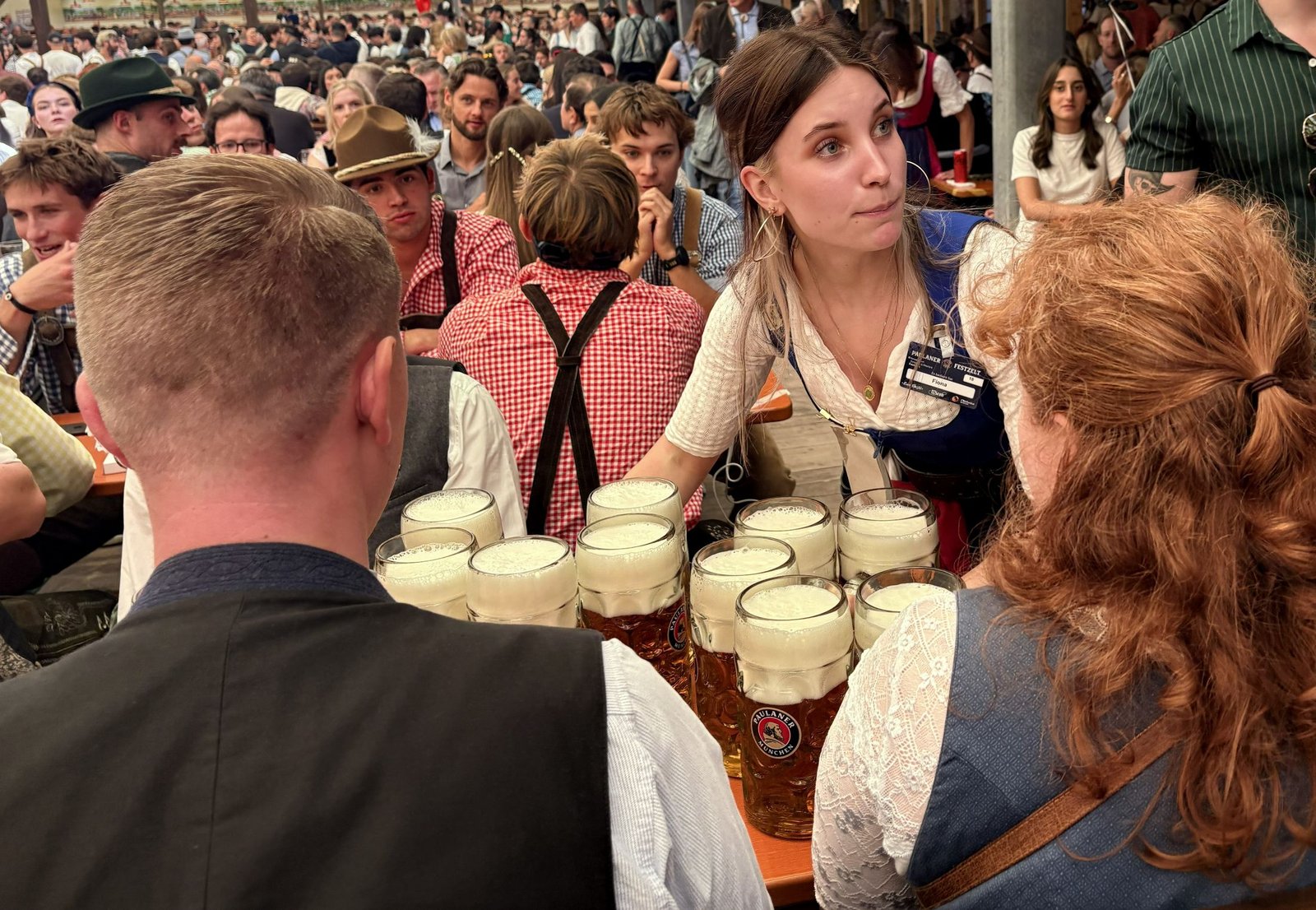
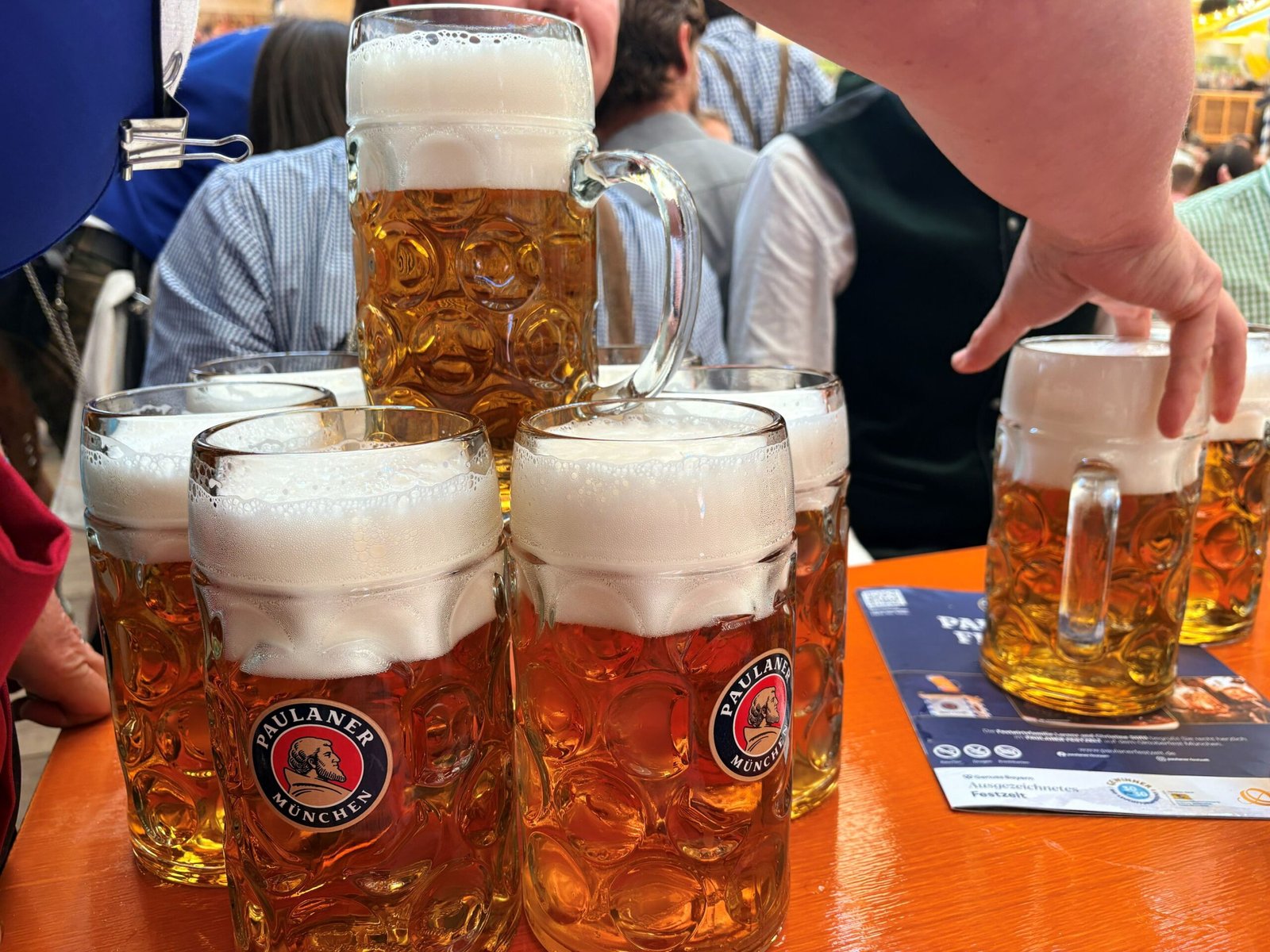
Servers started rushing around, hands full of Maß, thick glass mugs full of beer, roughly pronounced “mahss.” Each giant glass full of beer weighs around five pounds, and we saw servers carrying up to ten Maß at a time to serve a full table.
As we were in the Paulaner tent, only beer from the Paulaner brewery was served there. All Oktoberfest tents serve only local Munich beer, so sorry, Corona and Budweiser fans. I tried ordering a Radler, which is beer mixed with lemonade, but was told that until 1 pm, only Oktoberfest beer was being served. So, we ordered two Maß of Oktoberfest beer and got ours just in time to toast with the crowd. Everyone was singing “Ein Prosit, ein Prosit der Gemütlichkeit!” while swinging their Maß, toasting, and shouting “Prost!”
Full transparency: we had no idea what this song was, and as the band played it every twenty minutes, we made up our own words in English and Russian. Later, I looked it up and learned that it means roughly, “A toast, a toast to good cheer and fellowship!”
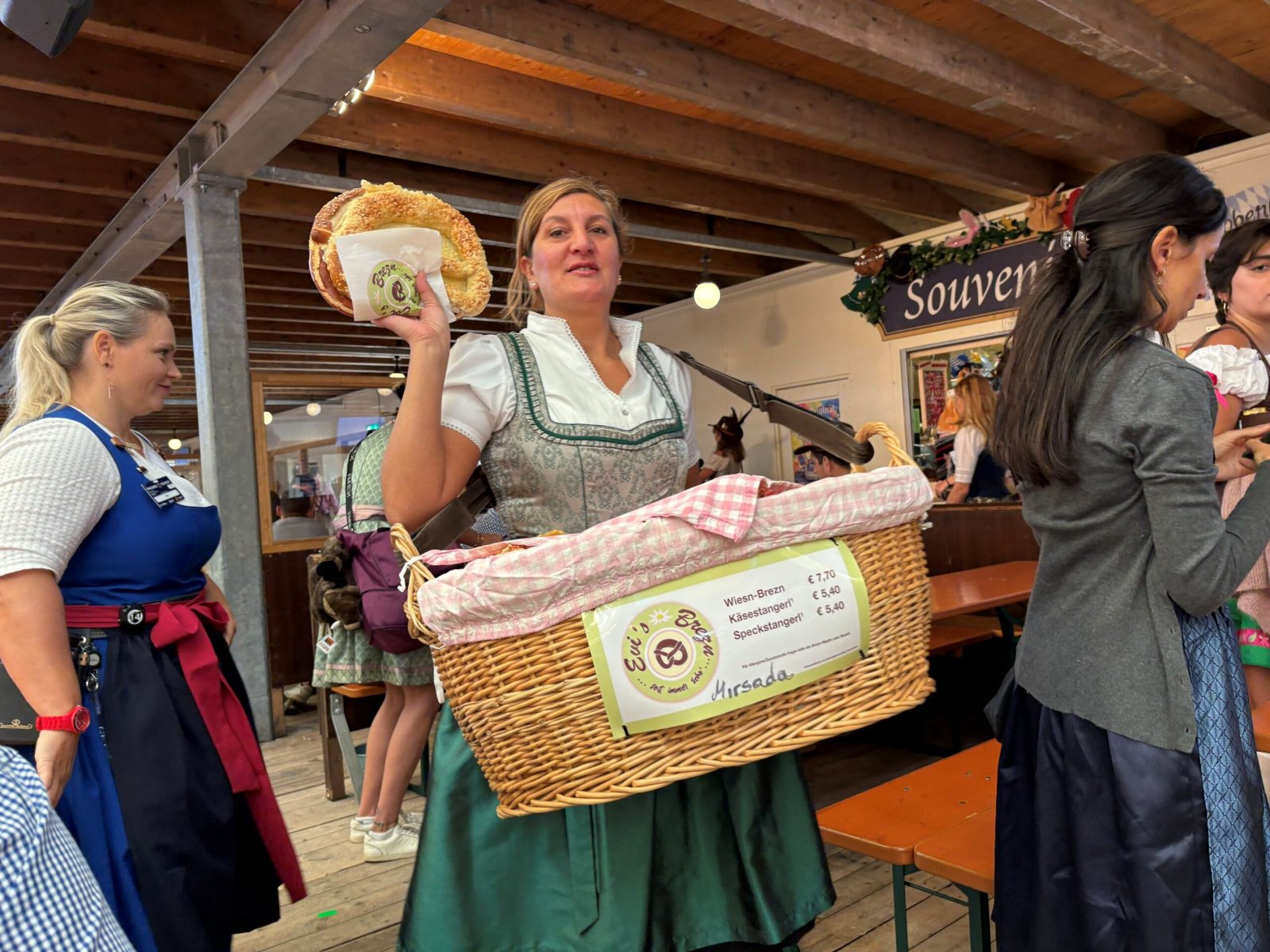
Soon, giant trays of food were being served: pork knuckle, roasted chicken, spaetzle, sausages, and plum dumplings. Women with giant baskets full of pretzels were walking the aisles, tempting us with every pass. We ended up getting a giant pretzel and traditional Bavarian spätzle (noodles) tossed with melted cheese and caramelized onions.
The liters of beer we were gulping down soon let themselves be known in a variety of ways. Besides the fact that we were having a jolly good time, Victor also needed to use the bathroom. He went to look for a bathroom and was gone for full twenty minutes.
“Was there a huge line?” I asked when he got back.
He looked flustered, “Not really...”
“So what took you so long?”
Well, apparently taking off leather shorts with the suspenders and the chest crosspiece while somewhat drunk and really needing to pee is quite a feat. Unsure of how to accomplish such an impossible task, Victor ran into a stall, rather than try to do this out in the open by the urinals. He ended up having a small workout by trying to removing the suspenders over his head and fully taking off the shorts.
“There are two buttons right there.” I said, pointing down at at his shorts, “They seem to be holding up a flap that can be pulled down...”
Victor looked down at his pants, felt the buttons and the flap with his hands, and sighed loudly. We had no time to giggle about this, as now I had to go to the bathroom, quite urgently.
There were at least a hundred women lined up outside the bathroom. I braced for a long wait, keeping in a back of my mind that all I have to do is lift a skirt, rather than wrestle with leather shorts and suspenders. Two young women in front of me, turned around and asked me something in German. I explained I don’t speak German and they both seemed very surprised.
“You are not local?” they asked in English. “We though you were from Munich, we were asking you where you got your beautiful dirndl.” I laughed and explained that I was from the U.S. and the dirndl was rented at a nearby shop. We were chatting pleasantly when I saw that it was already our turn to get inside the bathroom. Before I could say how surprised I was at how quickly this line was moving, a male voice screamed “NEXT!” and the girls quickly bid goodbye and ran inside.
“NEXT!” another bellow came out from inside. I ran in. There were multiple men inside the women’s bathroom, walking down the long row of stalls, knocking their fists on each door and the moment any of the doors swung open to reveal an empty stall or whenever a woman left a stall, a familiar call of “NEXT!” sent the next woman rushing in.
I had no time to gape or wonder why there were male employees in a women’s bathroom. Clearly this was normal here. To be fair, these were European stalls, not American ones. And what I mean by this is there were absolutely no gaps in these stall anywhere, not under the door, not over the door, not by the sides of the door. Each stall was solid, with a door going from floor to ceiling, no way to look inside.
I ran into an empty stall, latched the door and lifted my skirt. A few seconds later, a slamming of the fist sent my door flying open, directly into my head, as I was bending over the toilet.
“NEeeee...” the man called out and stopped halfway realizing the stall was not empty.
Clearly I didn’t latch the door correctly. Holding my skirt up with one hand, I latched the door with another. I walked back to our table with a bathroom story somehow even more embarrassing than Victor’s. We laughed and kept on drinking. At this point, there was no reason to hold back.
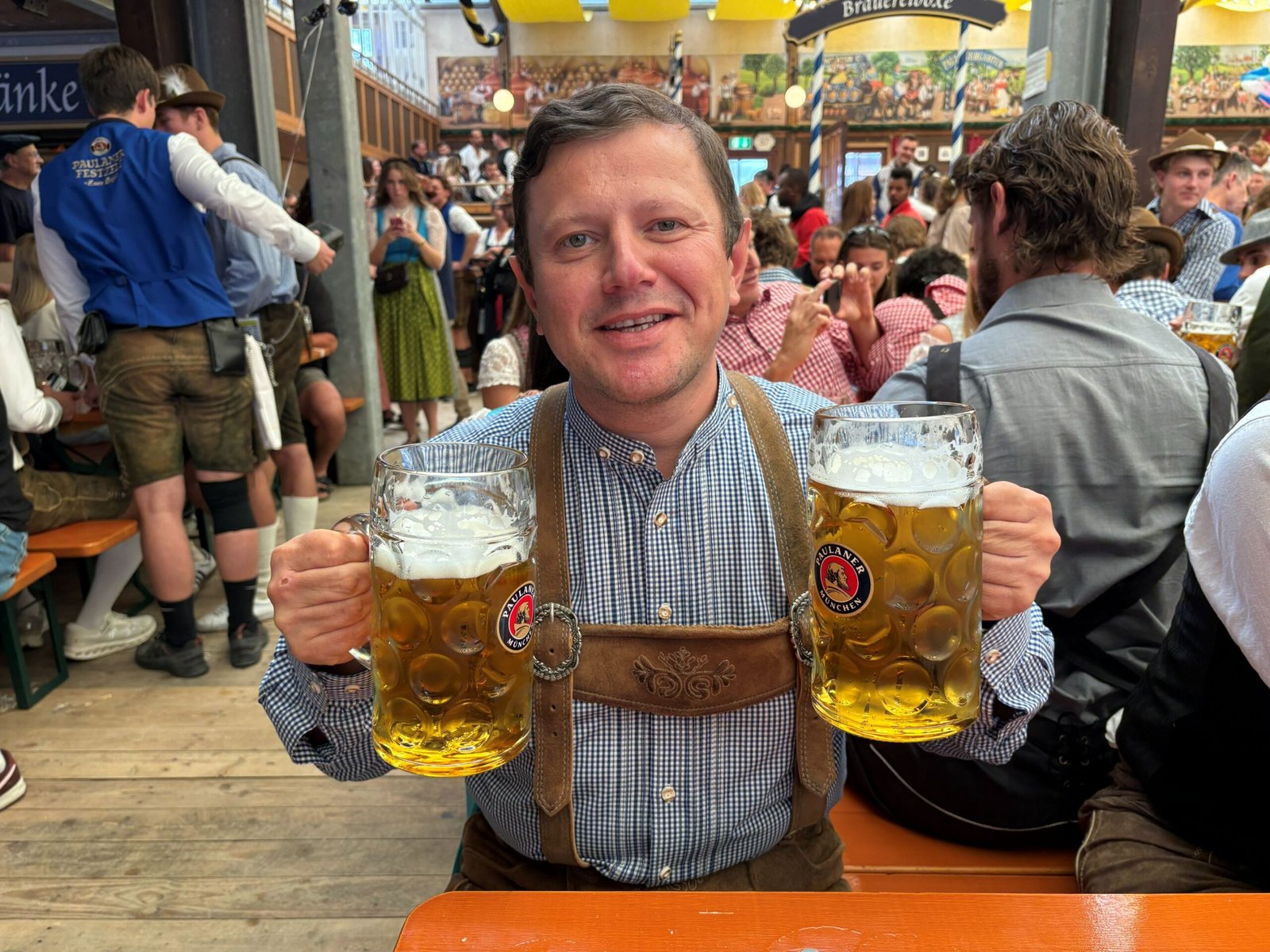
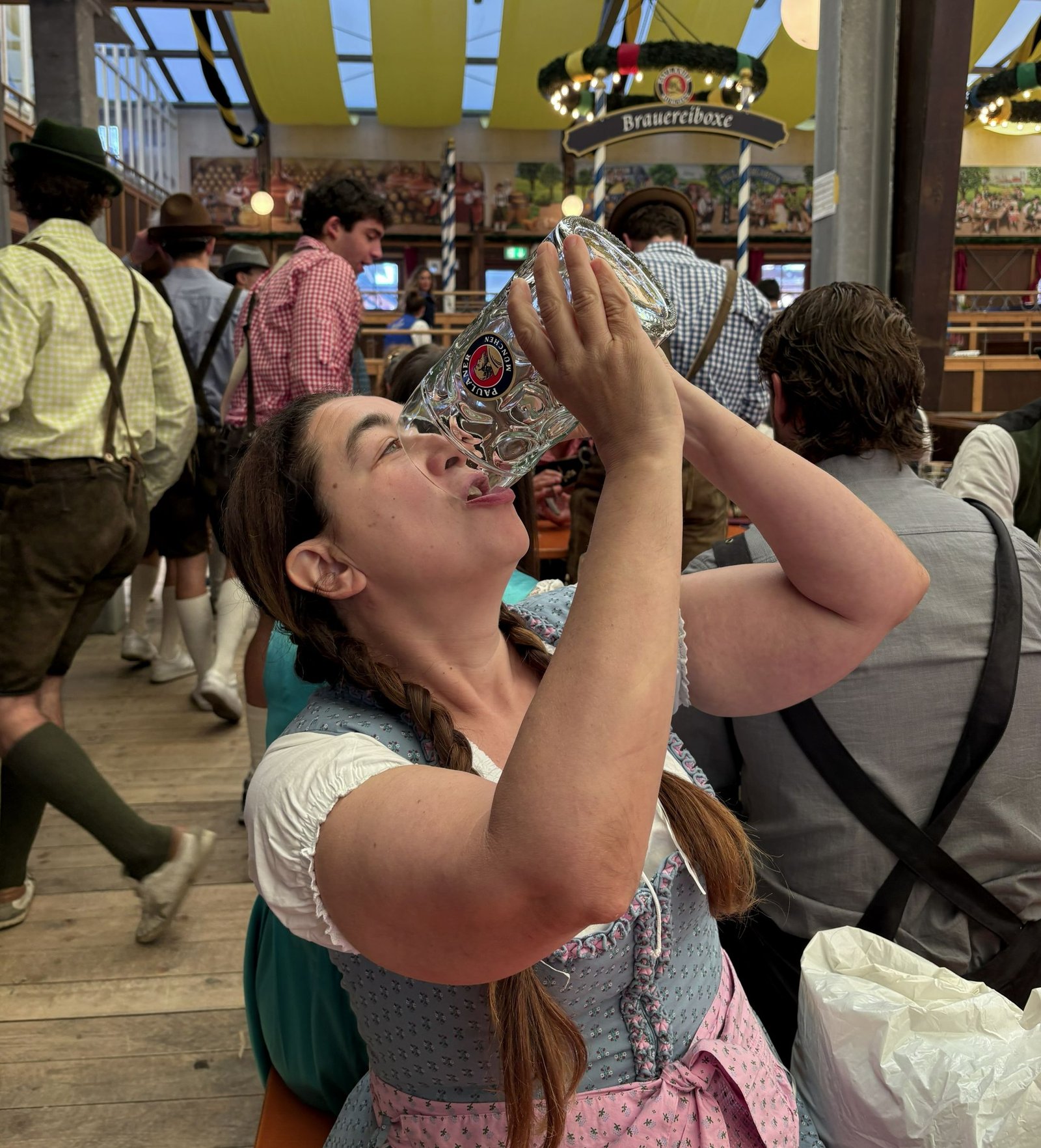
We got to know everyone at our table, chit-chatting about life between all the singing, toasting, cheering, and dancing on wooden benches. Despite the copious amounts of beer being consumed, we didn’t see anyone get blackout drunk or act inappropriately. From what we heard, that’s the major difference between lunch and dinner service in Oktoberfest beer tents: lunch is fun and easygoing, while dinner can get a bit chaotic.
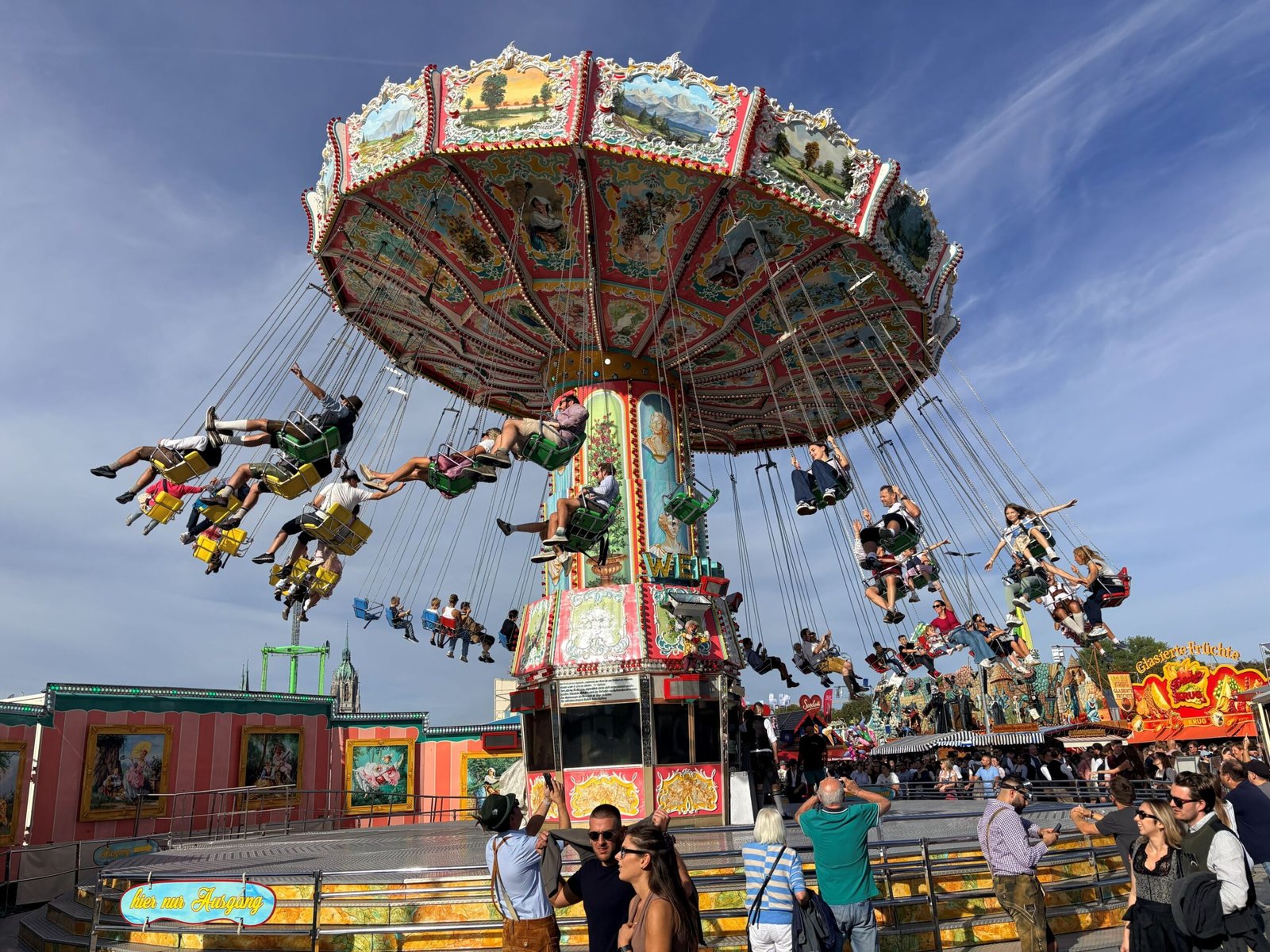
Before we knew it, it was 4 pm, and a crowd of people was lining up outside the tent, hoping to get in and claim tables for dinner service. We said goodbye to our new friends and went outside to wander around the fairgrounds, checking out all the food vendors and amusement rides. By then, the fairgrounds were packed, with music blasting from the tents, rides spinning overhead, and people in lederhosen and dirndls eating, drinking, and having a great time. It was impossible not to get caught up in the fun.
But, as our rented costumes had to be returned by 6 pm, we had to rush back to the store. Walking in, I didn’t realize there was a high step at the entrance and stumbled inside. The salesgirl who had helped us that morning saw me and grinned, “Looks like you had a great time at Oktoberfest!”
And while I wasn’t drunk, or at least not drunk enough to stumble into the store, she was absolutely right.