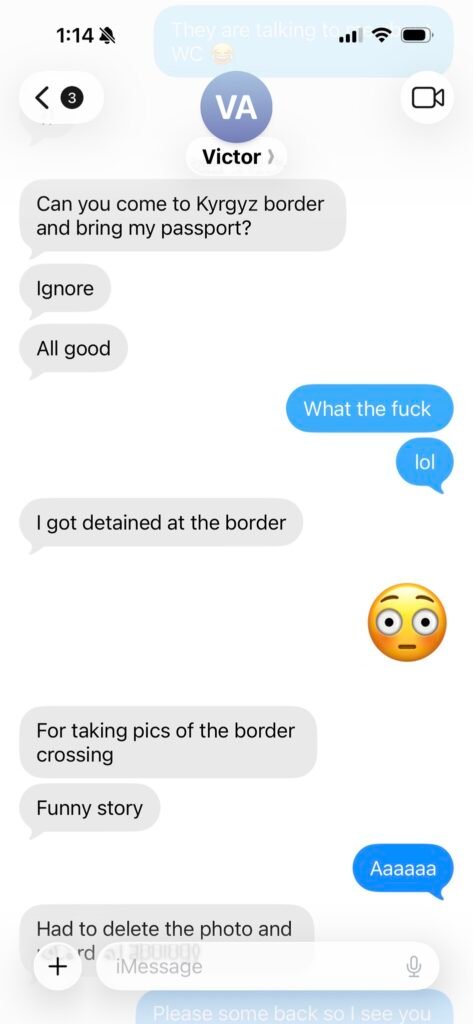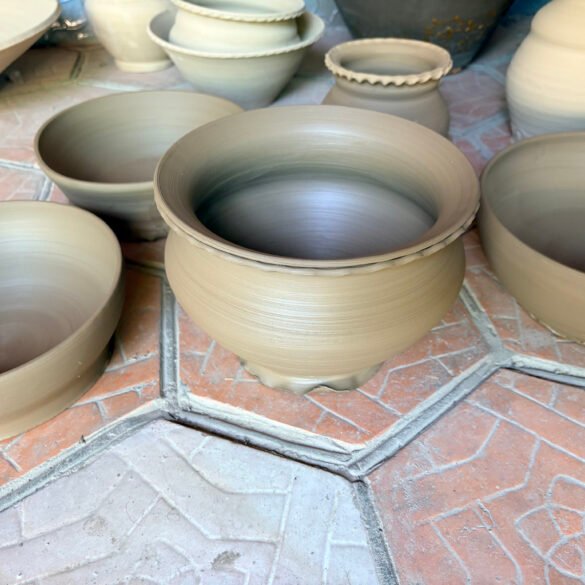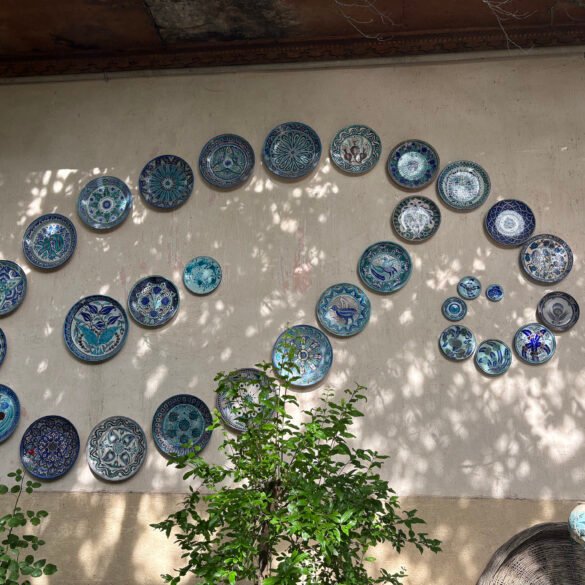

While Julia was busy taking pottery classes, I got my ass in trouble. Funny story.
When we arrived in Rishton, it was already dark outside, and we barely saw the surroundings. But as we settled for the night at the pottery studio, I looked at Google Maps on my phone and saw that we were just 100 meters from the border with Kyrgyzstan. Go outside, turn left, and in two minutes, you’ll be at the border.
As someone who travels the world, borders have always fascinated me. The border is both a restriction (as it separates you from people on the other side, who have their own customs, traditions, and food) and an invitation to visit and explore the new place. Every time we cross a border or travel close to one, I get excited.
In the morning, as Julia was getting her hands dirty with silky Rishton clay, I decided to check out the border. Because I was going to do just a short walk there and back, I didn’t grab my passport or wallet. I only took the phone.
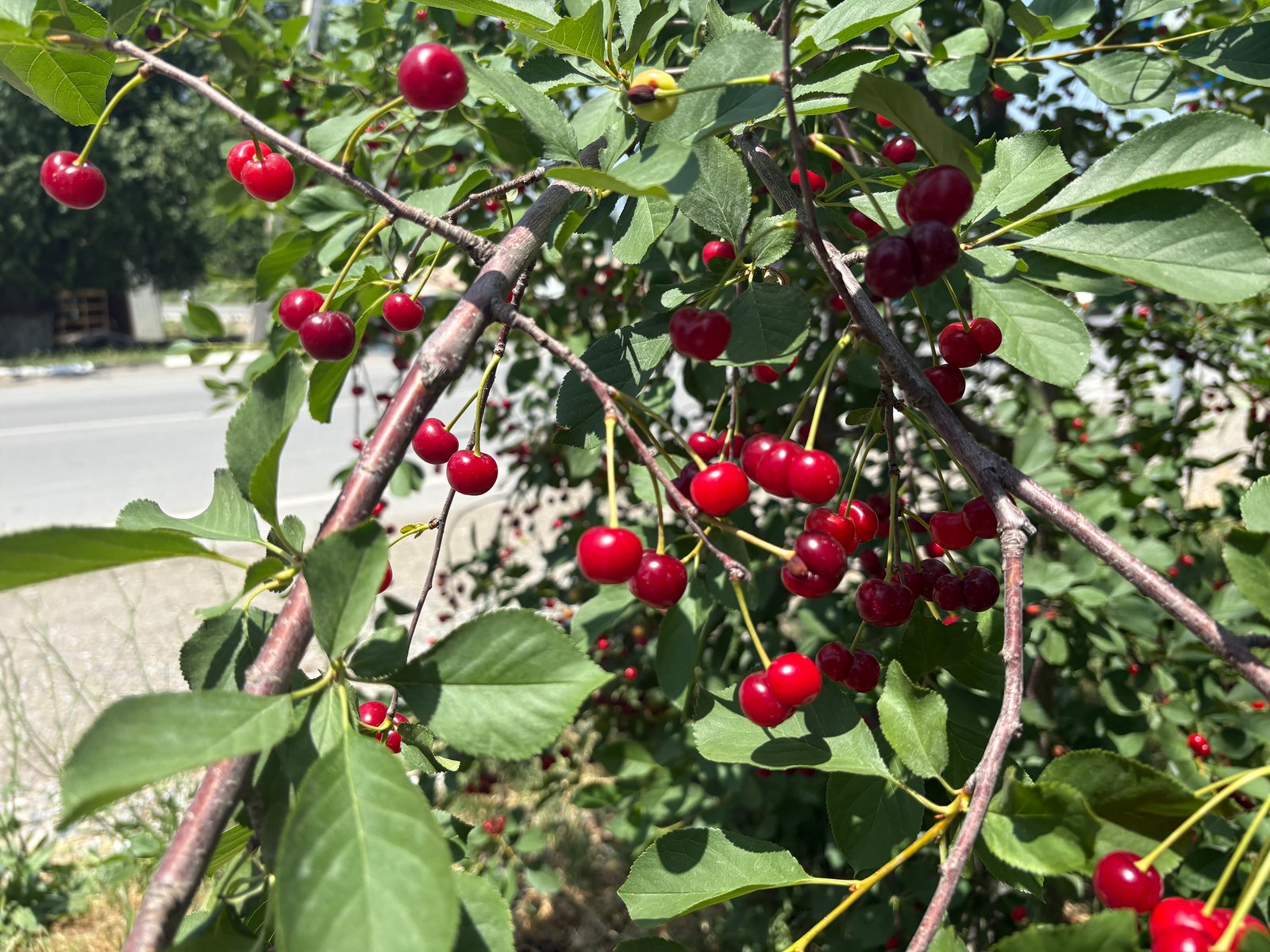
I left the studio and turned left. The dusty road had cherry trees on each side, and as I walked, I shoved palmfuls of delicious, sweet-and-sour cherries into my mouth, while trying not to stain my T-shirt.
The walk was even shorter than it looked on the map. I soon spotted in the distance a tall flagpole with a Kyrgyz flag. And right in front of it was the Uzbek-Kyrgyz border crossing post. The red flag of Kyrgyzstan beautifully rippled in the air. The entrance to Kyrgyzstan – a country we hadn’t yet visited – was within walking distance from where I stood. I looked at the flag and imagined our future trip to this Central Asian country known for its majestic mountains, nomadic culture, and one of the deepest lakes in the world.
The border crossing was small, even tiny, in comparison with the one near Tashkent that we used for our “visa” run to Kazakhstan. There was not much to see or do by the border, really. Without even getting closer, I snapped a picture and turned around. I wanted to check out a makeshift market that had been set up nearby.
Suddenly, I heard shouting.
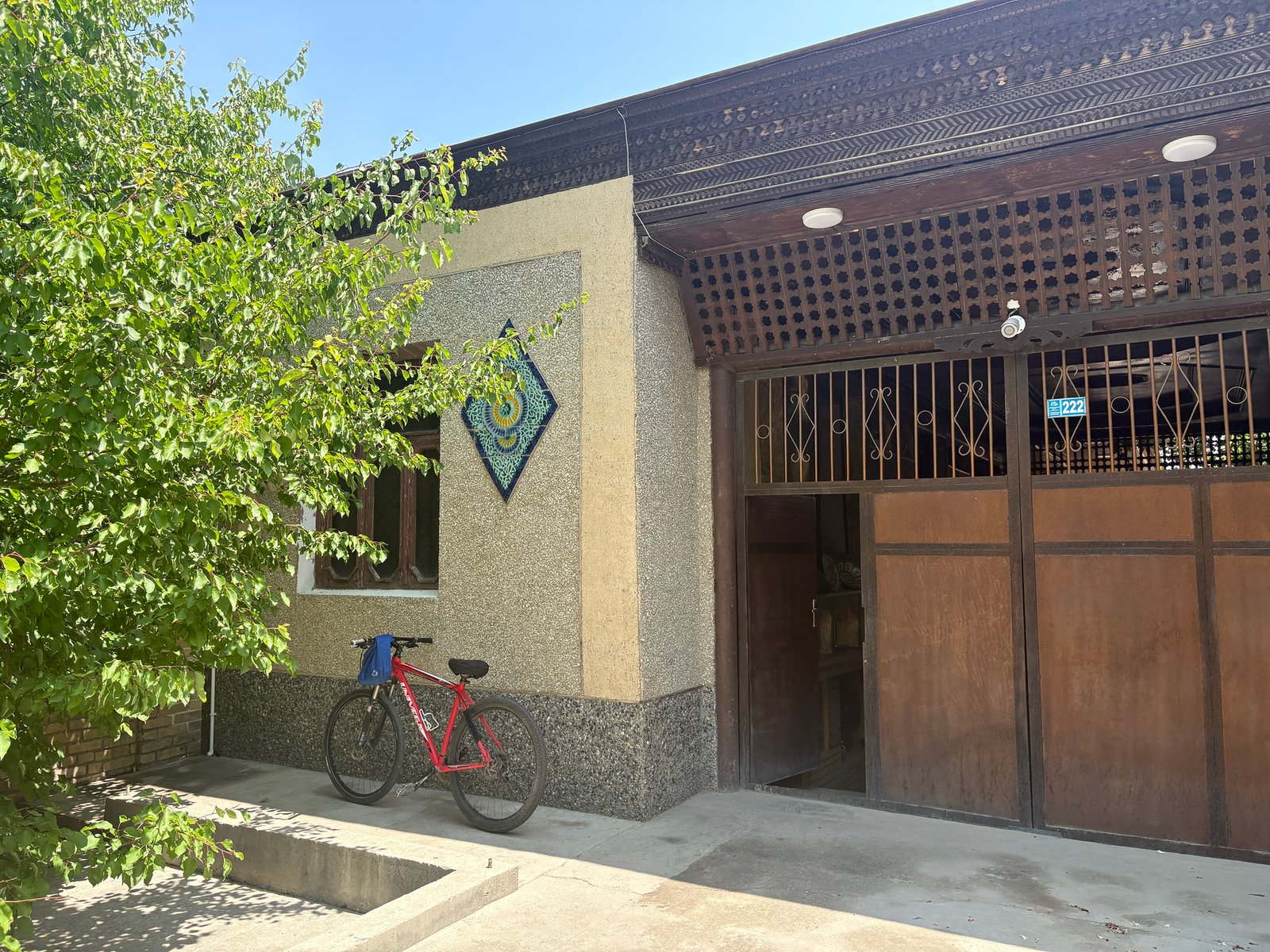

Someone was yelling from the border direction.
With my back to the border, I didn’t pay attention initially. But as I looked at the people in the area, they were all making eye contact with me and nodding toward the border. One man told me that someone wanted to speak with me. I turned around and saw a border control agent in big aviator glasses making his way toward me.
“Who are you and what are you doing here?” He barked at me in Russian, and before I could react, he snatched the phone from my hand.
He rushed back to the cordoned-off zone by the border, so I had to follow him.
“I am a tourist.”
“Why are you taking pictures of the border?”
“Is that prohibited? I just took one.”
We got inside the buffer area, and he slammed the gate behind my back.
“Unlock your phone!”
The border agent was short, a little bit pudgy. The big aviator shades sat awkwardly on him, and he looked like a big, clumsy fly.
I unlocked my phone, and he zoomed in and out of the picture.
“Who sent you?”
“Nobody. I am a tourist. We’re staying at the pottery studio right there,” I motioned toward where the pottery studio was and told him about Julia taking pottery classes in town.
“Show me your passport!”
“I don’t have it on me. It’s in the pottery studio.”
“You must carry it with you all the time”.
“I didn’t know you had this rule.”
Actually, I knew that this was the rule in Uzbekistan, but because I was going for a short walk, I didn’t think I needed it. Now, I was interrogated as if I were an undocumented alien or a spy who somehow sneaked into the country without documents.
“Go and get your passport.”
“Give me my phone back.”
We were standing there, looking at each other, locked in this awkward stalemate.
Meanwhile, the metal gates opened and closed as people who crossed the border got in and out of the buffer zone. But I was trapped inside with this obnoxious border agent firmly holding on to my phone.
I couldn’t quite understand what the fuss was about. What’s the big deal? It’s just one photo. I took the picture of the Uzbekistan-Kazakhstan border near Tashkent, and we didn’t have any issues.
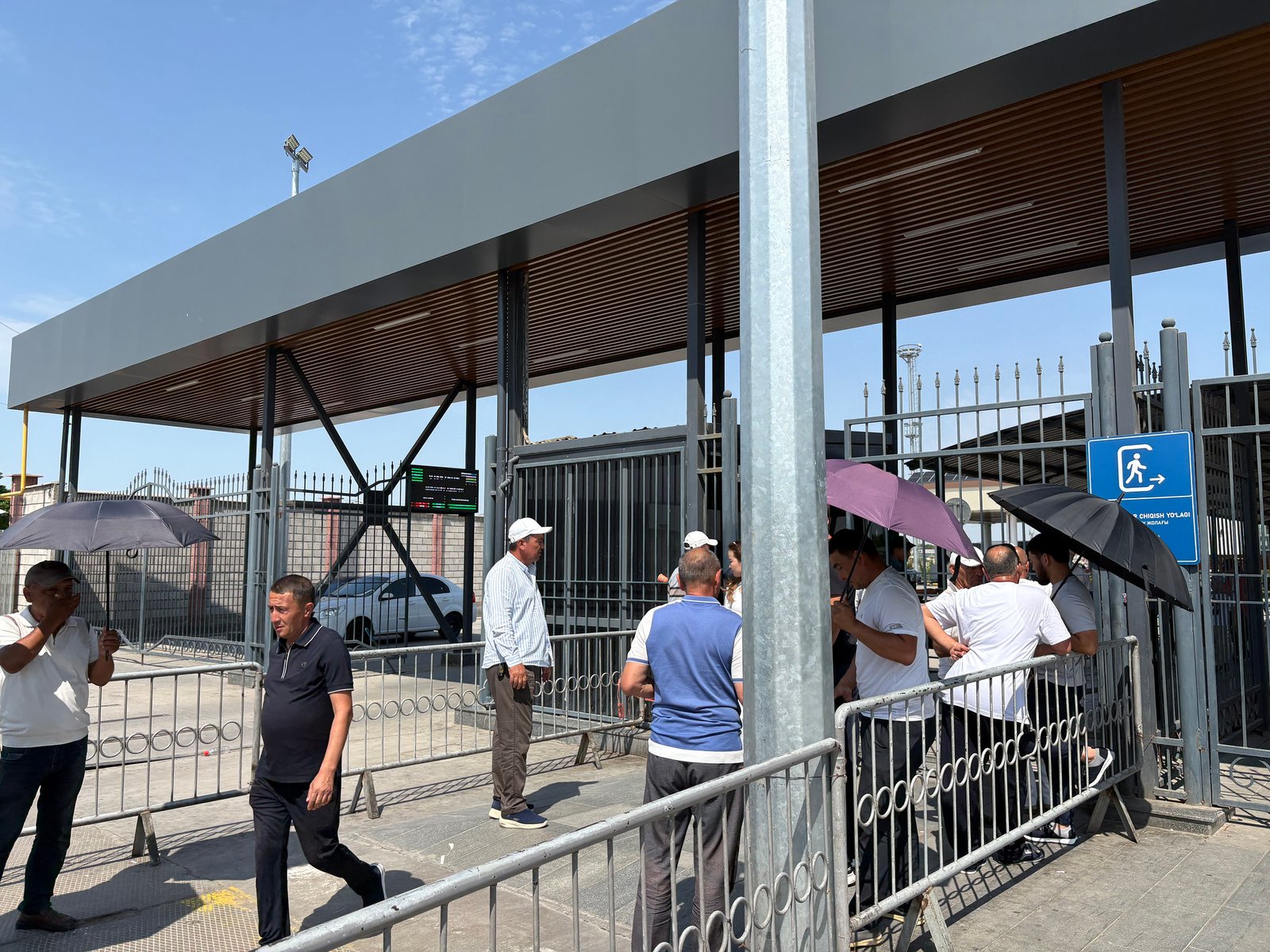
But it looked like I brought excitement to this little, sleepy border outpost. This low-level border control agent felt like he caught a potential spy. Later, Julia asked me if I was nervous during this encounter, and I wasn’t. But I was annoyed that due to taking one stupid picture, I could potentially disrupt the work of the pottery studio or, worse, trigger the need for diplomatic interference. It’s just one photo. Can you let me go?
The situation soon escalated to Level 2 Support.
The agent handed me a major, who took over my interrogation. The major was taller, more composed, and less hysterical than his colleague.
He examined the picture of the border crossing that I took and then took a picture of the picture with his phone.
“What’s your occupation?”
“I’m a lawyer.”
“And you don’t know that you’re not supposed to photograph the border?”
“I am a tourist. I photograph everything.” I was tired of repeating the same explanation, but I felt I had no other option but to repeat my version of the events.
“Can someone get your passport here?”
“Let me call someone.”
The major handed me the phone, and I dialed Julia, but she did not pick up.
I then sent her a text message: “Can you come to Kyrgyz border and bring my passport?”
No response. She was busy making pottery.
“I don’t think she’ll respond any time soon,” I told the major. “She is taking pottery classes.”
The major took my phone and started to go through my photos.
“Is that her?” He pointed to a picture of a smiling Julia, who was making a ceramic bowl on a wheel.
“Yes. See I’m not lying to you. I took this picture this morning. We’re staying in this town for pottery classes.”
The major continued scrolling through my pictures.
“Who is this?”
“My mom. We travelled together through Uzbekistan. She already went home.”
As he was going through my pics, I was just glad that I didn’t have any nudes on my phone (ha-ha-ha).
“Do you have a picture of your passport on your phone?
“Actually, I do.”
The major examined my passport pic, took a picture of it, and handed my phone back to me.
Are they going to let me go now? Is this over?
“Delete the photo that you took!”
I complied.
“And now delete it from the bin.”
After initially fumbling to find the Recently Deleted folder, I permanently deleted the unfortunate photo.
I thought I was free to go.
“Alright, and now, you will record an apology video.”
“What?!”
“An apology video.”
“What apology video? Are you serious?”
Were I Will Smith, who needed to record a video apology after slapping Chris Rock at the Oscars? The whole situation was ridiculous, but I just wanted to be done with this circus.
“OK. I’ll do it.”
As the major was about to hit the Record button on his phone, it suddenly occurred to me:
“Wait, in what language do you need an apology? English or Russian?”
“Russian! I don’t know English. Who knows what you’re going to say in English?”
“My name is Victor Allen.” I began in Russian, trying not to laugh while the major was pointing his phone camera at me.
“I am a citizen of the United States, and I took a picture of the Rishton border checkpoint. I didn’t know I wasn’t supposed to photograph the border. I apologize for my actions and will not do it again.”
The major nodded satisfactorily, gave me a thumbs-up, and opened the gate.
I was FREE!
I did my walk of shame back to the pottery studio without looking back at the border.
I spent the rest of the day recuperating from this bizarre encounter. The students at the pottery studio laughed when they found out about my adventures and kept joking about it for the rest of the day.
“Where is Victor?”
“I don’t know. Maybe check the Kyrgyz border?”
Interestingly, before 2005, there was no border crossing post in Rishton at all. People were free to choose where to live and moved around easily. Now, apparently, it’s a big deal.
Brandt’s Uzbekistan guidebook has a lot of valuable information, but this advice is gold:
“It is not worth having your camera kit seized just for the sake of an otherwise useless picture of a typical border post or concrete bridge across the Amu Darya”.
Amen!