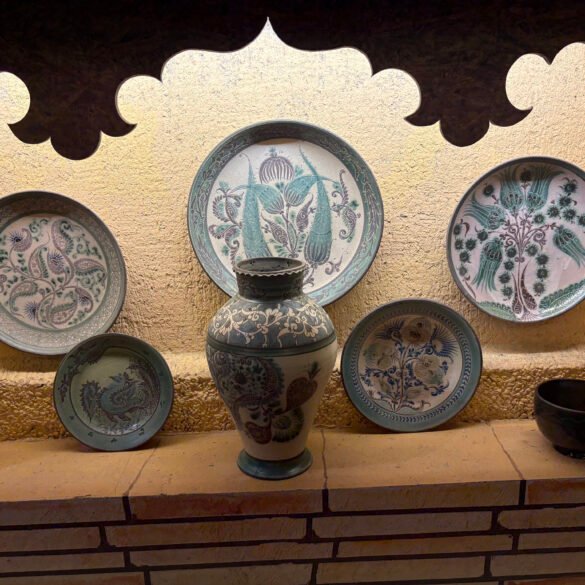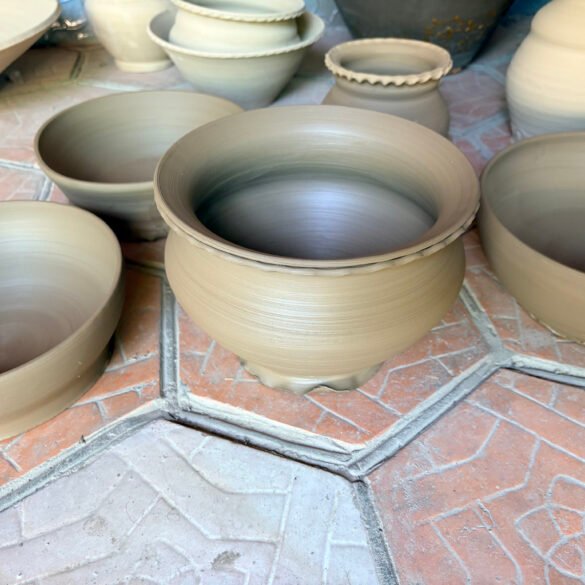

It was late evening, and we had just arrived at the pottery studio of one of the most famous ceramic artists in Uzbekistan. We were exhausted and sweaty and weren't sure if our long day of travel was over or if we would now need to look for alternative accommodation.
"Welcome!" the host said, and a wave of relief washed over me. We were here. We were expected. Meanwhile, the small quiet courtyard exploded into chaos. All the students dropped what they were doing and began rushing around. Someone ran to our ancient taxi to help Victor with our backpacks. Others started clearing the table; a few came out of the shadows to see what the commotion was about and to introduce themselves. An old man came out of the kitchen with an emerald pot full of aromatic green tea and a plate of strawberries.
We said goodbye to our taxi driver, who insisted on giving us his phone number in case we needed "reliable transportation around town," slapped the trunk of his 1983 Zhiguli closed, and took off down the dark road, smoke billowing out of his tailpipe.
Soon we were seated at a table in the courtyard, sipping tea from delicate pialas with our host. We would later learn that everyone called him simply "Master." His students, apprentices, employees, neighbors, and even friends who had known him since childhood never used his name. To all of them, he was just "Master." It was a title of deep respect, recognizing both his place in the community and his extraordinary skill. He was, quite literally, a master of his craft.
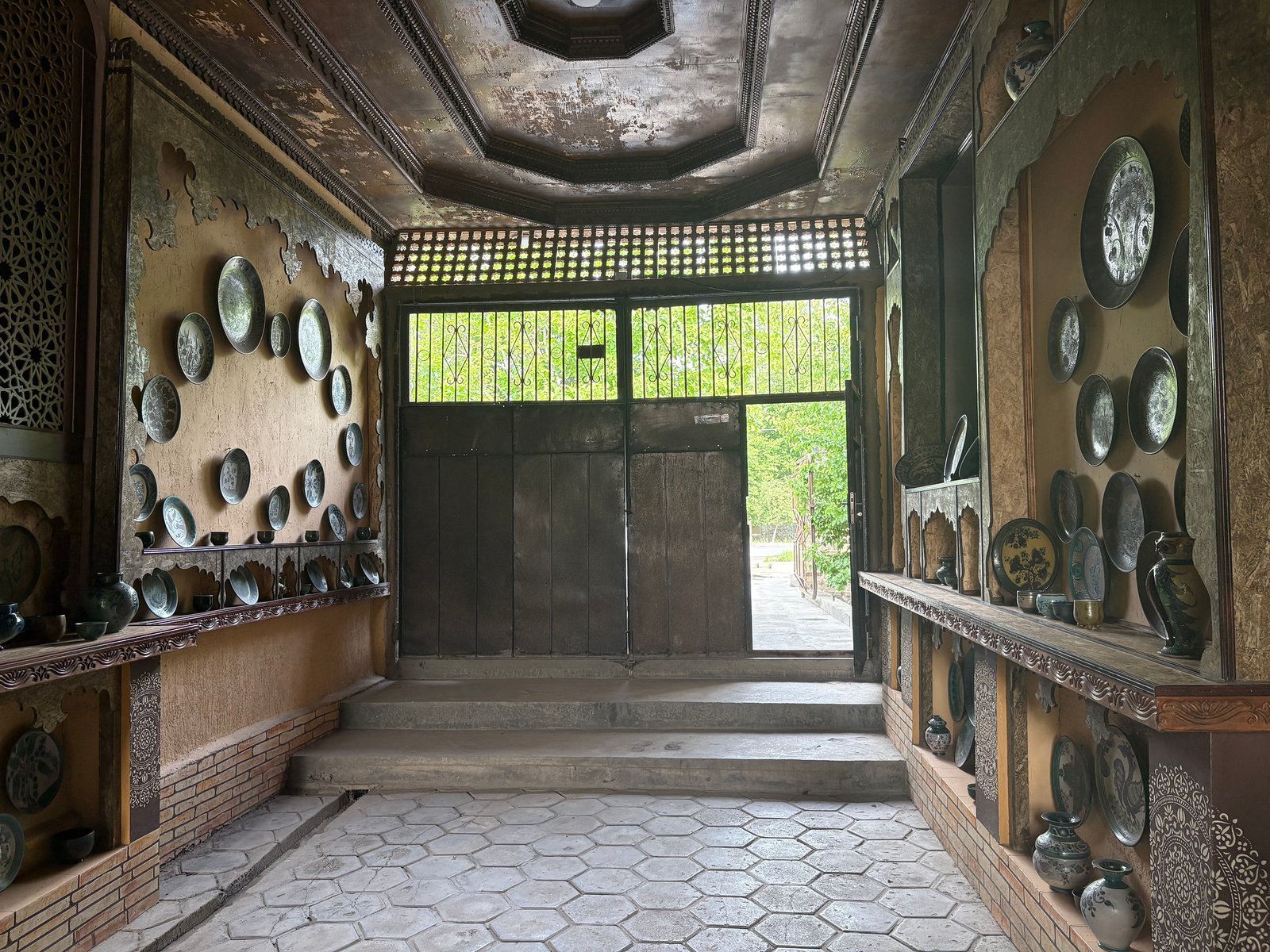
The courtyard around us was swallowed by darkness, but each time the lamp above our table swayed in the breeze, its light illuminated the pottery adorning the walls. The Master noticed my fascination and immediately began to share the story of Rishton ceramics - the clay, the glazes, the techniques passed down through generations, the deep history of Uzbek pottery going all the way back to the times of the Silk Road.
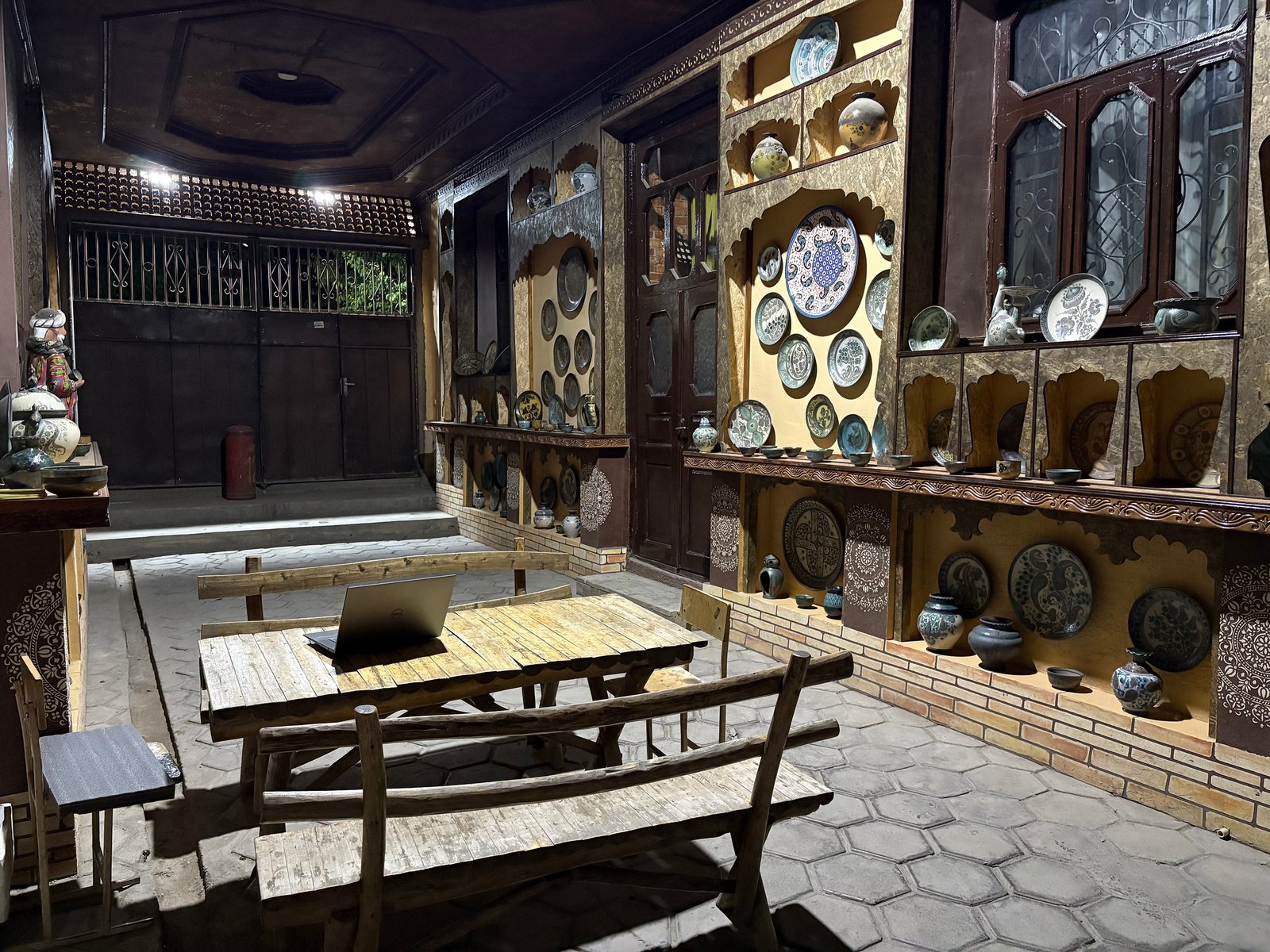
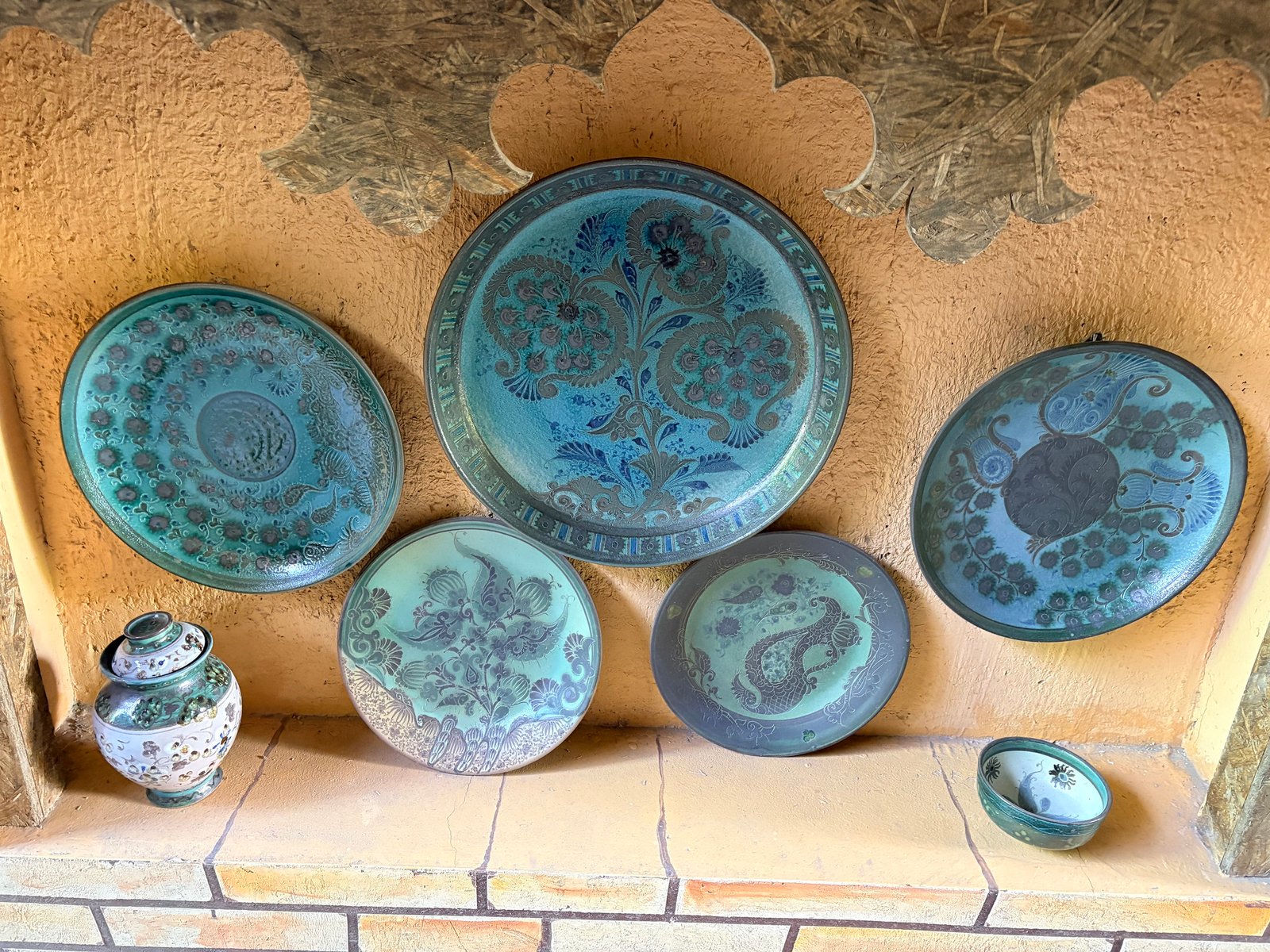
Before I could get to the practical questions about pottery lessons or prices, I was already sitting through my first lecture. While I tried to maintain composure, deep inside I was panicking. I could not believe this was really happening. I felt like a complete imposter. I did not deserve to be here, and I certainly lacked the practical skills to be learning from a craftsman of his stature.
Meanwhile, Victor was absolutely fascinated by the lecture. He was listening attentively, occasionally throwing incredulous glances at me, and at one point he leaned in and whispered, "Can you believe this!?"
In fact, I could not.
Then the Master told us that unfortunately, the next morning, he was expected in Bishkek.
"They called me to come for an international ceramic conference. I told them I have important guests from America, but they begged me to come. I am asked to do a lecture on Uzbek pottery traditions. I shouldn't miss it... You can start out learning with my students; they will get you through the basics until I come back in four days."
I assured him that of course he should go and I would be fine learning with his students. In my head I was counting days and realized that we would need to prolong our trip here if I wanted any time with the Master himself.
Suddenly, the Master rose from the table.
"Let me show you to where you will be staying. It's a remodeled caravanserai!"
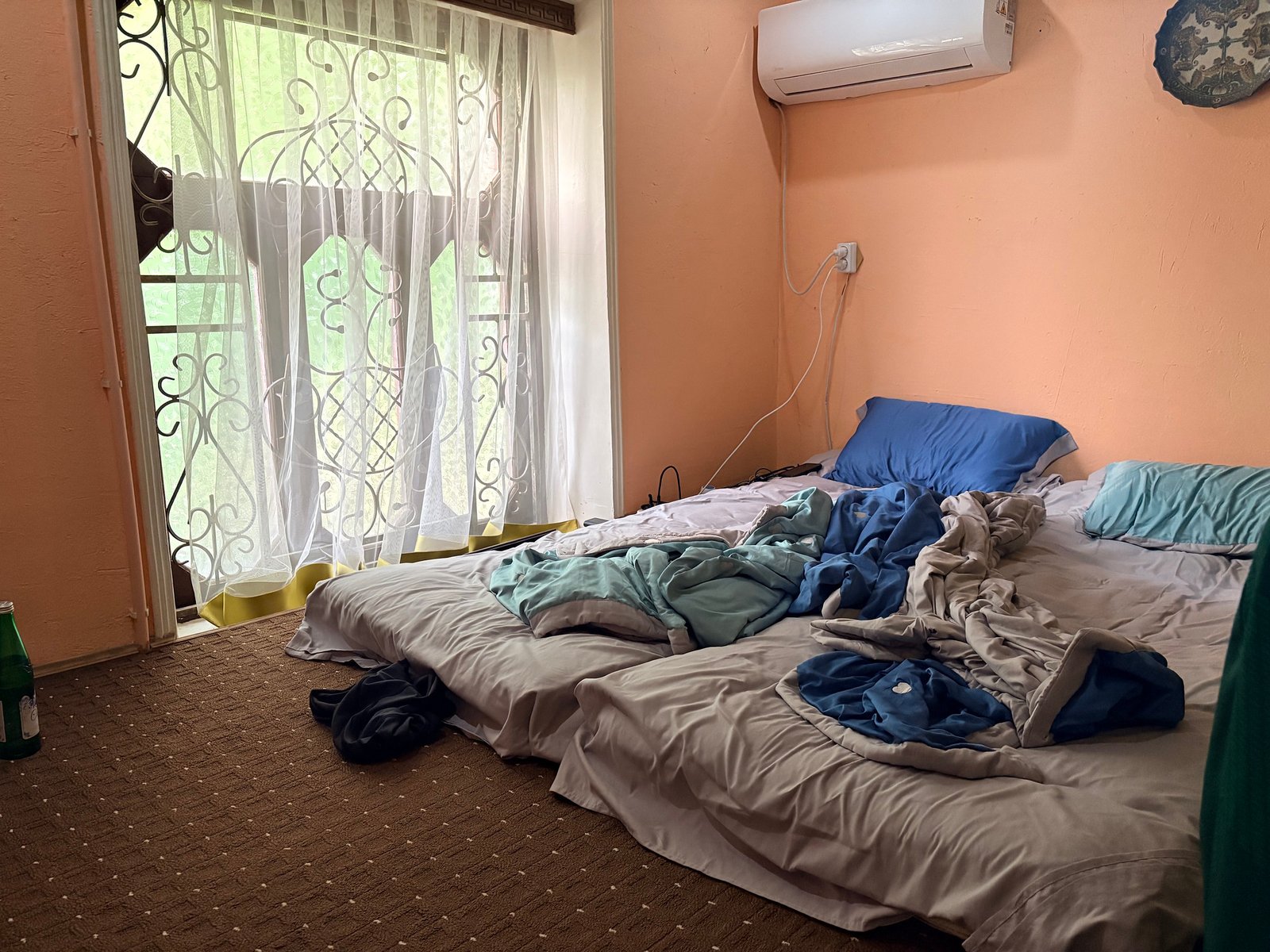
Caravanserai were lodgings for travelers, merchants, and caravans traveling the Silk Road. We walked in to find that there was a first-floor area, usually used to accommodate horses or camels and to store merchandise, and a second-floor loft, used as a bedroom. The Master proudly pointed out that there was a European-style bathroom and a window air-conditioning unit. As we had no pack animals or merchandise with us, we simply left our backpacks on the first floor.
The second floor had two thin futon mattresses on the floor and fresh linens. The Master told us that he was not a generational ceramic artist, as many are in Rishton where the father passes his skill to his sons. He fell in love with the craft, interned as a child with a local master, and as a college student moved to Japan to study with highly respected Japanese craftsmen. It was in Japan that he learned to appreciate minimalism and floor sleeping.
"We've been to Japan, we are used to these arrangements!" I assured him quickly, trying not to think of the fact that both of our backs hurt for weeks after getting back from the Japan trip. At the moment, I didn't care if I had to sleep in a barn with horses and camels; I just wanted to stay. From the corner of my eye, I saw Victor nodding along.
We went back outside and I could see that the Master was getting ready to leave for the day. I still had no idea how much all of this was going to cost us. I asked for the total price, trying to sound casual, and whether he preferred to be paid in Uzbek soms or U.S. dollars.
"Food and boarding are $31 per day for both of you. Akram will feed you three times a day," he said, nodding towards the old man who brought us tea and strawberries earlier, "But really, all of my students can cook well. Sometimes we take turns in the kitchen."
"And the lessons?" I asked.
"The lessons? The lessons are free."
I stood there, speechless.
"I never charge for my lessons. All of my students get free instruction. Why would I charge? I don't want my skills to die with me. I want our pottery traditions to outlive me, I want Uzbek people to know their own traditions, and I want the world to learn of our beautiful craft. Foreign students coming here and learning will help spread my knowledge and skills outside of Uzbekistan. That's all I ever wanted."
I wanted to admit - I am not worthy of this. My skills are not up to par with what you are offering. I am sorry I wasted your time. I will leave.
I wanted to scream - travel companies are selling pottery lessons for thousands of dollars on TripAdvisor with other masters in the area! You can charge me an arm and a leg!
I wanted to cry. I was overwhelmed by what I felt at that moment. I was thankful, I wanted to prove myself, I feared failure, I was confused by the generosity.
I swallowed hard. I said, "Thank you." And left it at that.
He smiled, wished us a good night, and left.
We went inside the caravanserai and found that there was another room to the right of the bathroom, unoccupied, with the same layout. If other guests came, we would have to share the bathroom. We crawled upstairs, carefully folded the linens, and dragged the futon mattresses to our room. After doubling up the mattresses, it was now possible to sleep in relative comfort.
The water in the bathroom had a somewhat swampy smell. I couldn't tell if it was the water itself or just a smell from the drain. As I stood there, pondering how to fix or minimize that issue, Victor simply said, "Smells like hot springs! Remember sulfur baths in Georgia? We can pretend it's like that." And that was it.
As we lay on the futon mattresses, trying to fall asleep, I said to Victor, "I know it's not that comfortable. Thank you for putting up with all these inconveniences for me to have this experience."
"Are you forgetting we've slept in airports and sheds? This is luxury. Tomorrow, we'll figure out what we need to cut out of our itinerary to stay here a few days longer."
I closed my eyes. Tomorrow. I could not wait until tomorrow.