

I woke up the next morning with my heart fluttering. It was the first day of my pottery retreat. I threw on older clothes I didn't mind getting dirty with clay and hurried outside.
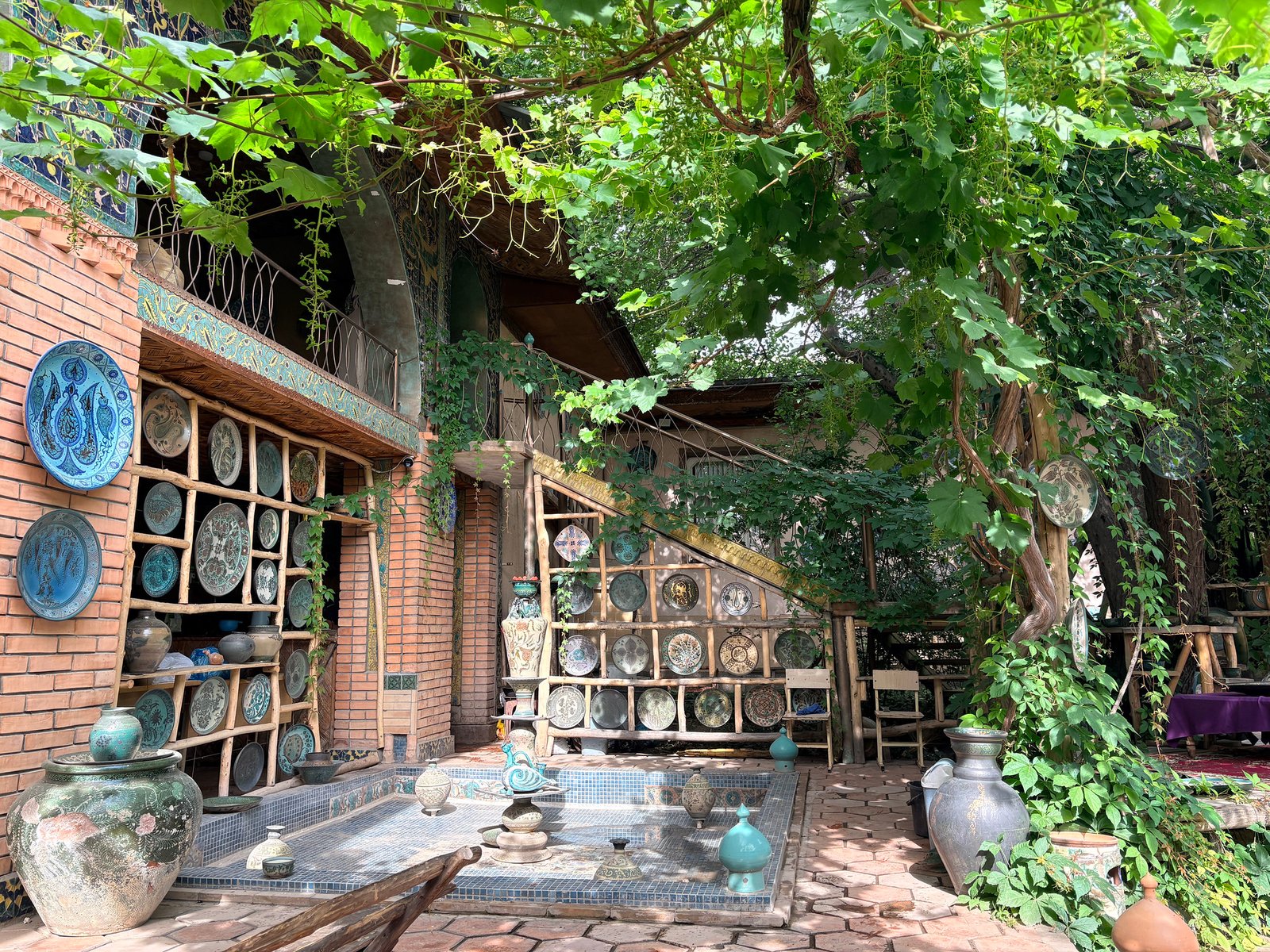
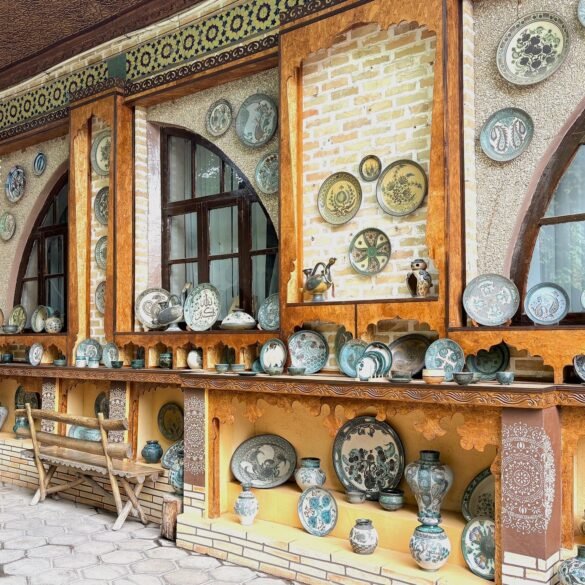
I hadn't really seen the courtyard the night before. We arrived after dark, when little was visible beyond the glow of a single lamp. Now, morning sunlight danced across hundreds of plates, bowls, and vases covering the walls, and I stood there transfixed. Over the previous two weeks, we wandered through the architectural masterpieces of Bukhara and Samarkand, admired world-class ceramics at the Museum of Applied Arts in Tashkent, and hiked through beautiful landscapes. Yet here, in the small town of Rishton, far from the usual tourist trail, I had found the most beautiful place in Uzbekistan.
The courtyard was empty except for a few fancy pigeons cooing around the fountain. I wandered quietly among the displays, admiring the pottery and the intricate designs painted on each piece.
Grandpa Akram emerged from the outdoor kitchen with his wide, gap-toothed smile.
"Breakfast!"
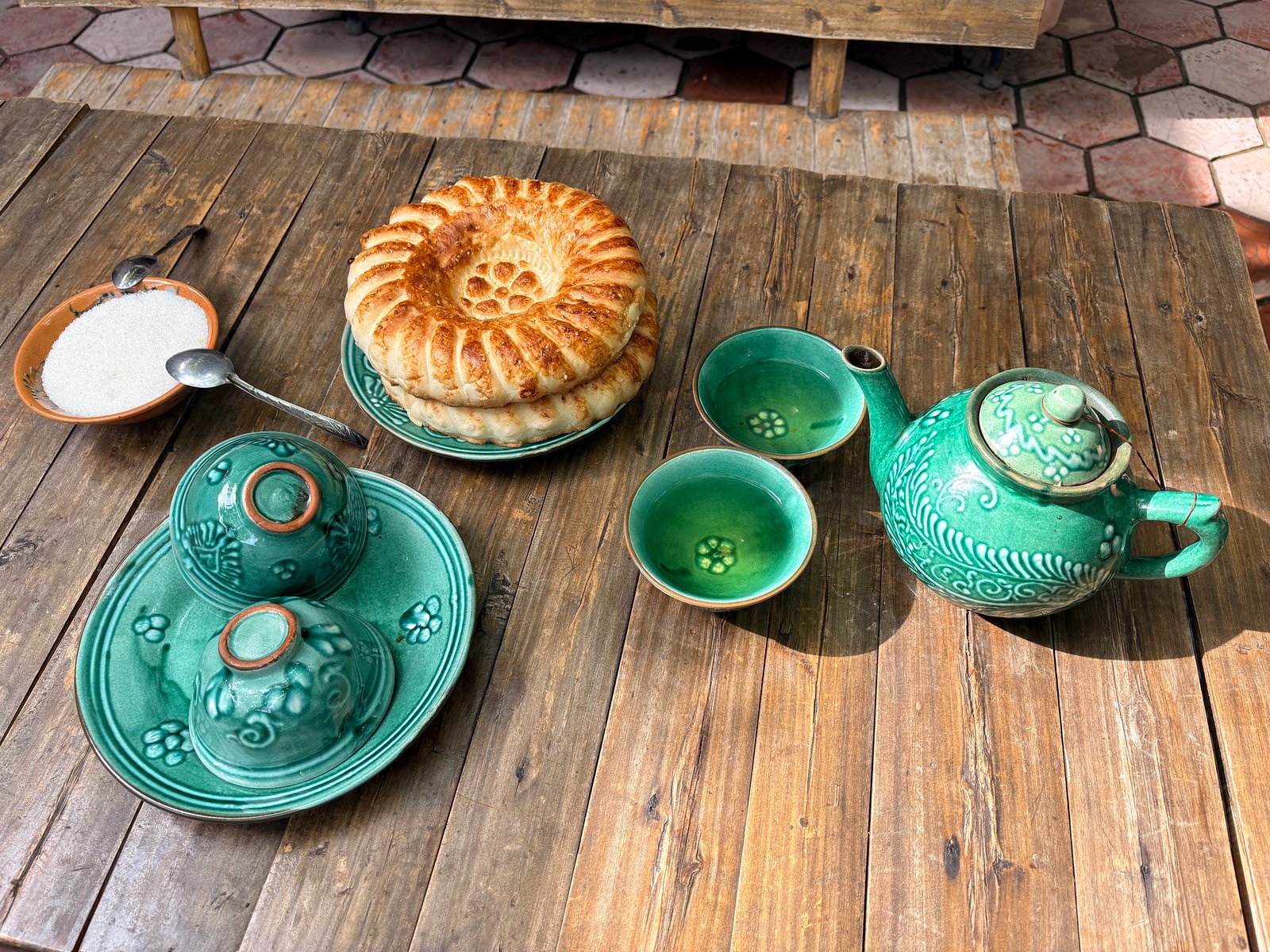
I called for Victor, and we sat down at the table. We were the only ones awake, the rest of the students still sleeping in. Breakfast was a traditional homemade Uzbek spread: freshly baked lepeshka, the round flatbread cooked in a tandoor, served with rich qaymoq, thick clotted cream, along with boiled eggs and a pot of hot green tea. Everything was fresh and delicious.
Soon, Khushnud appeared, rubbing the sleep from his eyes. A young man in his early twenties, he had spent the last five years studying under the Master and would be teaching me on the pottery wheel. We chatted while he grabbed a quick breakfast from the kitchen, then he showed me around the studio.
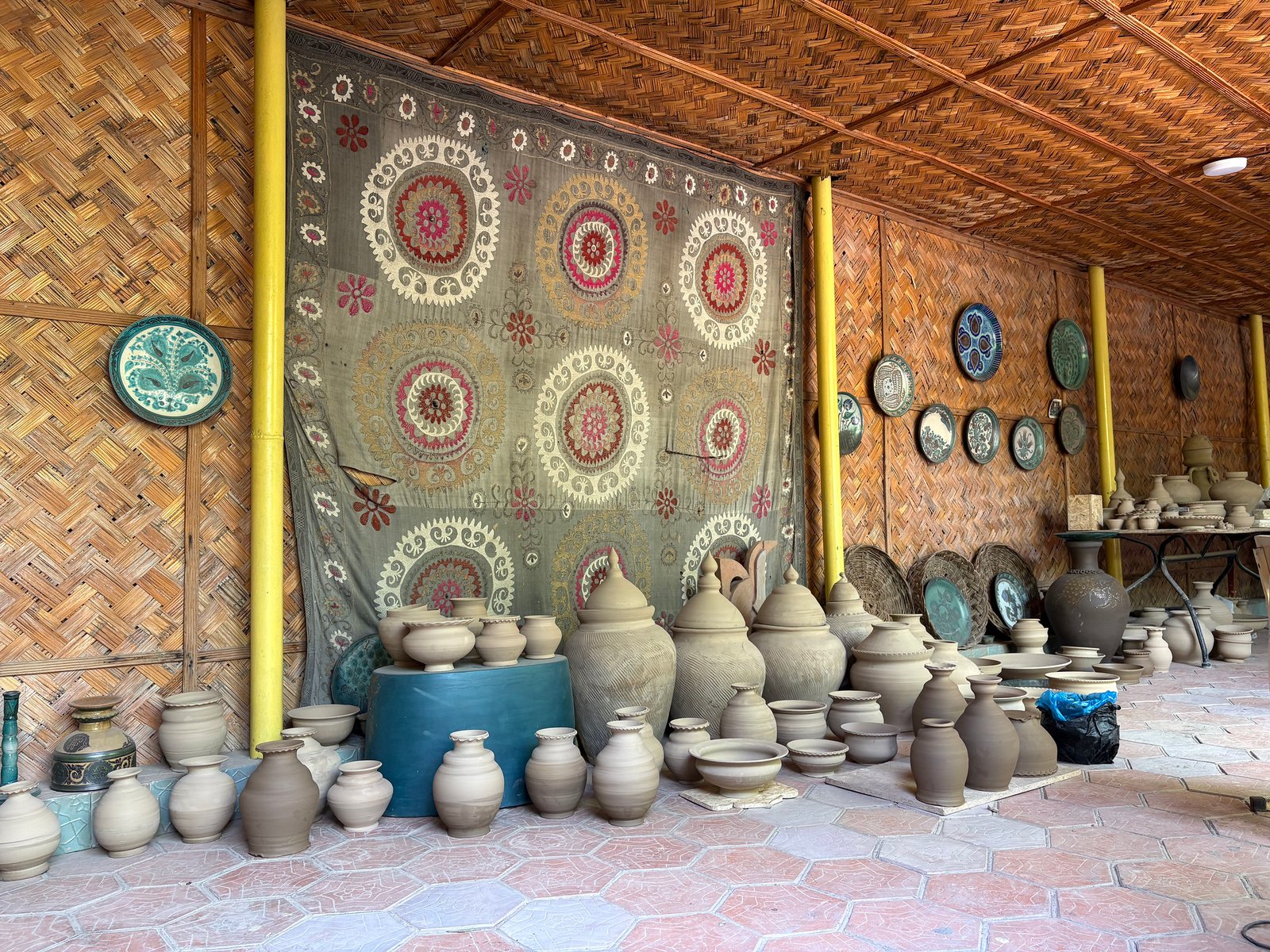
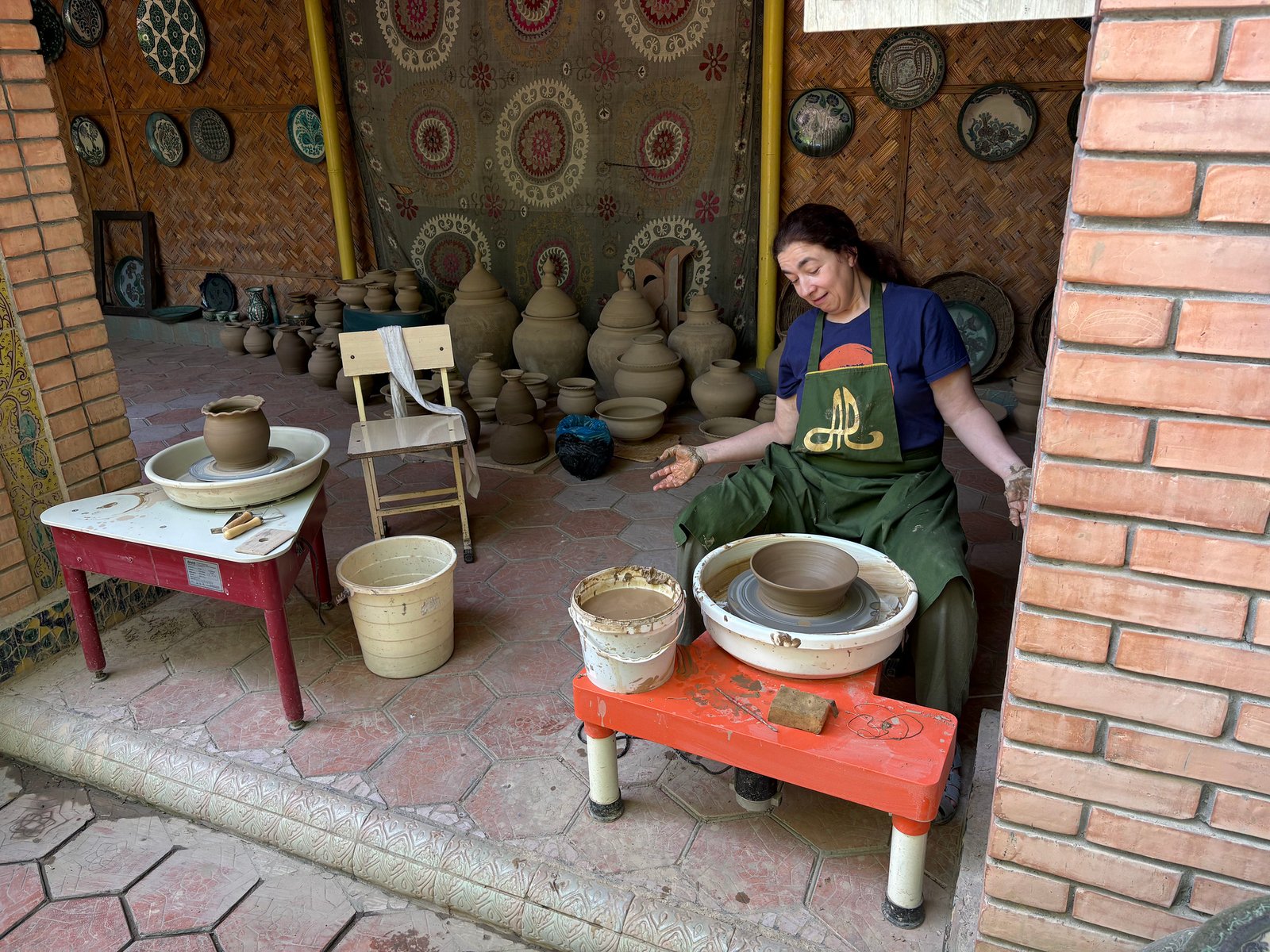
The workshop was a fascinating blend of centuries-old tradition and modern equipment. In one corner stood an old kick wheel, the kind potters had used for thousands of years before electricity. The heavy lower wheel had to be kicked continuously in a steady rhythm to keep the upper wheel spinning.
"This wheel is 150 years old," Khushnud said. "Every student starts on a kick wheel. The Master says you have to learn pottery with your whole body: your hands, your feet, your head, and your heart. Everything works together."
"Every student?" I asked, imagining my entire week disappearing into learning how to operate this ancient contraption.
"Almost every student," Khushnud replied with a grin.
I was relieved to see several electric wheels lined up along the opposite wall.
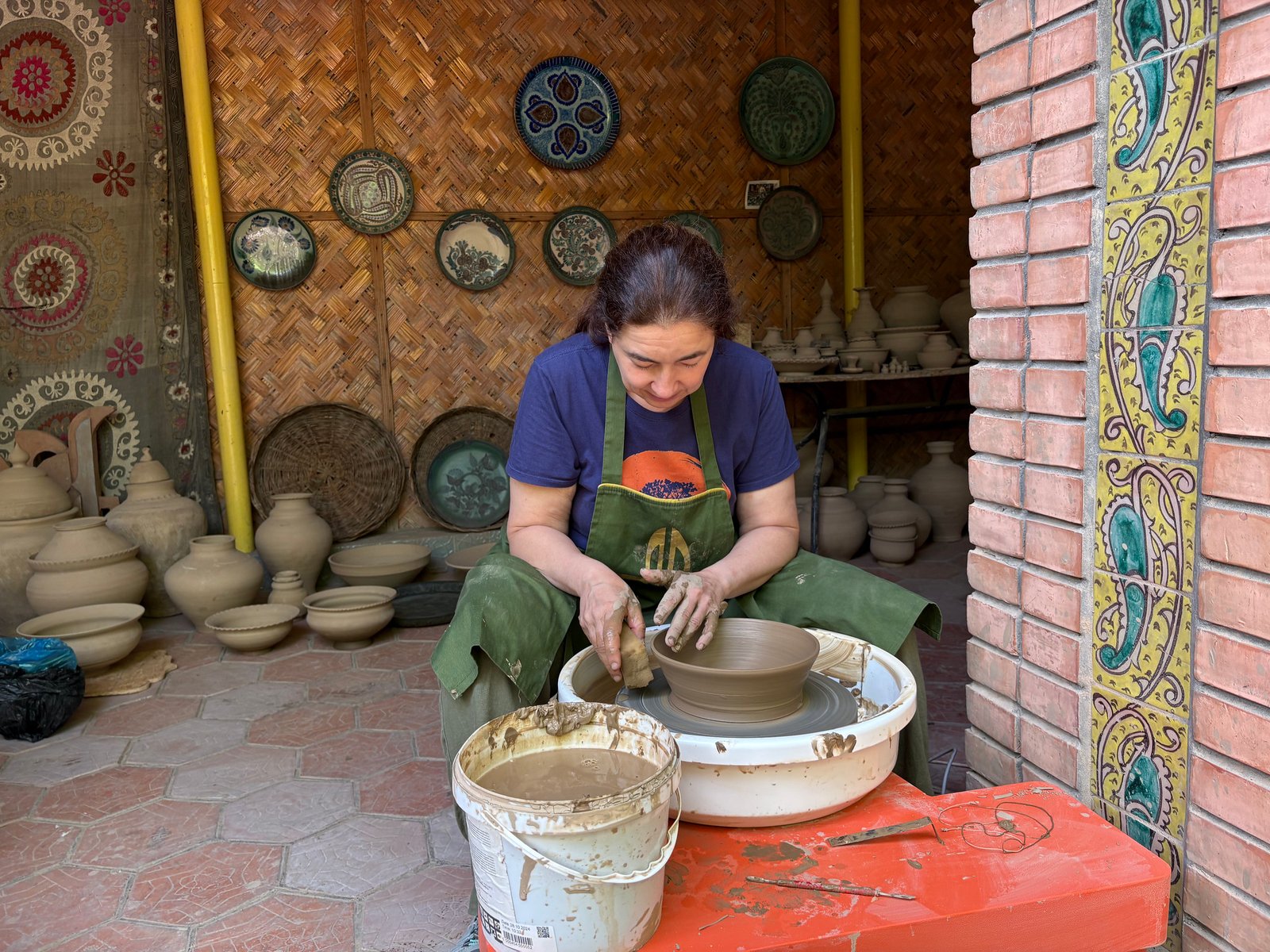
It was finally time to get my hands dirty. The clay was reddish, smooth, and noticeably firmer than what I was used to at home. I cut off a few pounds, dropped it onto the floor, and wedged it, using my body weight to force the air bubbles out.
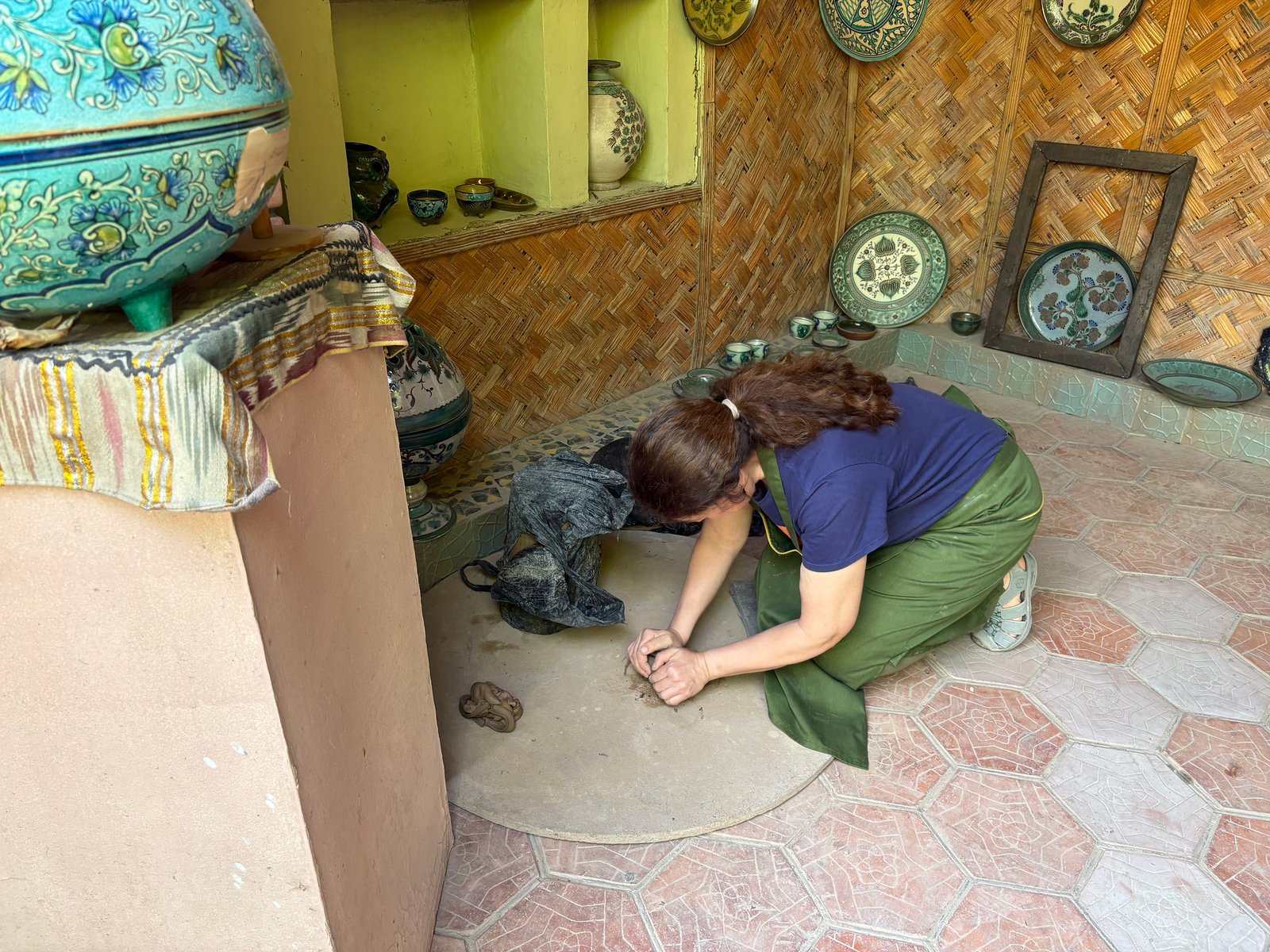
"In my country, only men work with clay," Khushnud said casually. "Women usually decorate and glaze."
I smiled and nodded. I don't travel to other countries to teach people how they should live. My choices are simple - accept their customs or leave.
I slapped the clay onto the wheel, wrapped my hands around it, and began centering. The wheel spun. My hands held firm. The clay refused to move.
This wasn't casual sexism, I realized.
The clay itself was incredibly stiff. To center it, I had to lean over the wheel, lock my entire body, and use every bit of strength I had.
To get a feel for the clay, its consistency, grit, and structural strength, I decided to start with a few simple bowls. As I worked with it, I came to appreciate just how forgiving this clay was. At home, I mostly throw B-Mix and porcelain, both delicate clays that punish every careless movement. Rishton clay was the opposite. It absorbed water well, tolerated repeated pulls, and let me reshape it again and again without collapsing.
As I grew accustomed to it, my confidence returned. Bowl after bowl emerged beneath my hands, and before long I slipped into that quiet, meditative rhythm only pottery can create. The soft cooing of the pigeons, the cool morning breeze, and the steady hum of the spinning wheel dissolved all other thoughts from my mind.
Khushnud wandered over and examined my work.
"Oh," he said thoughtfully. "Are you making bowls for pets?"
I burst out laughing.
"It's just... they're so plain," he said apologetically.
"Then please teach me how to make bowls fit for human consumption," I said, wiping tears of laughter from my face.
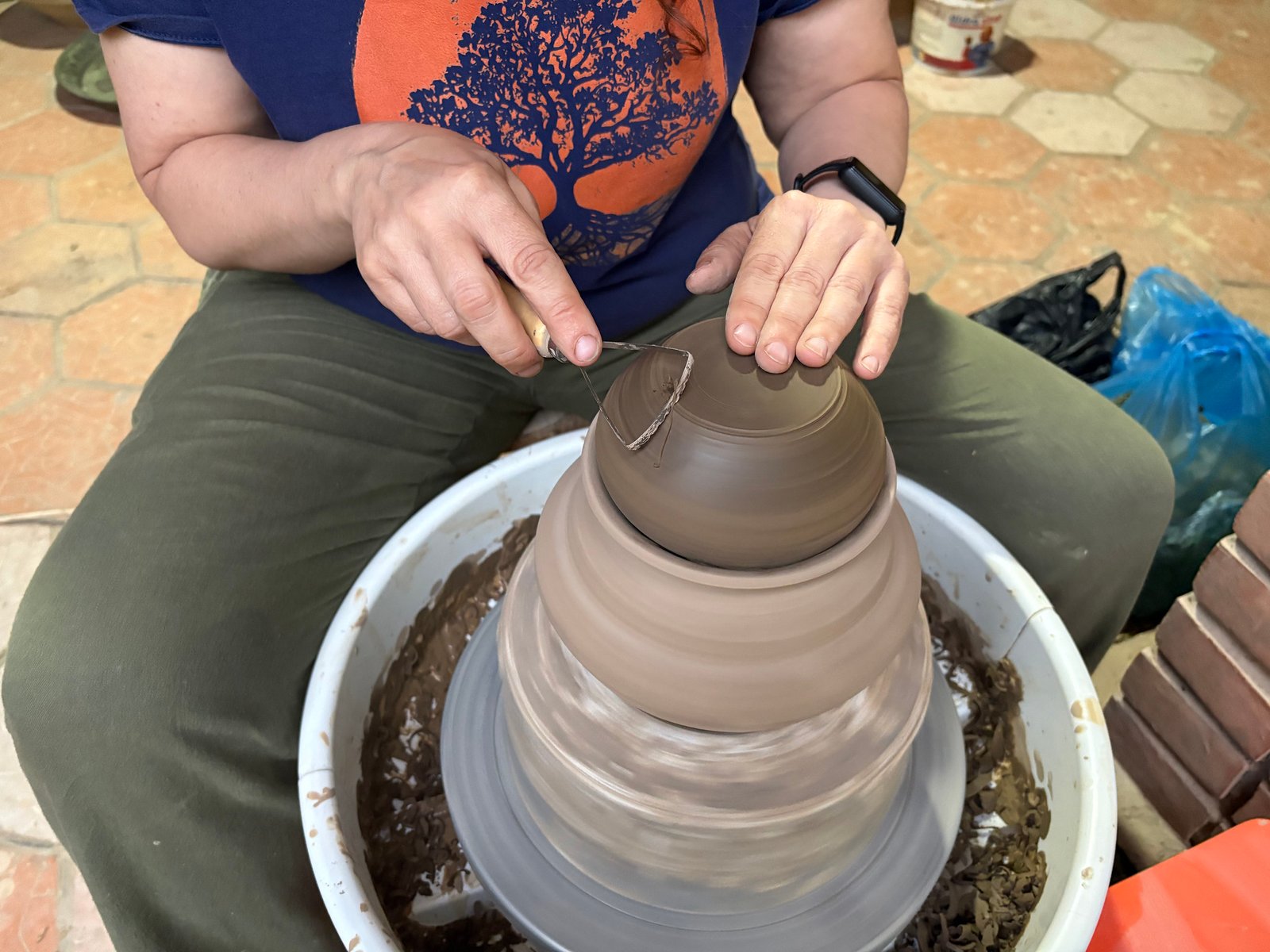
He did. The rest of the afternoon was spent learning traditional Uzbek forms, decorative rims, and how to use the local ribs and shaping tools.
Grandpa Akram served a lunch of soup, salad, bread, and fresh fruit. After a short break, I moved on to work with Khamidulo on decorating pre-thrown plates.
Khamidulo was a senior student in his late twenties who had spent more than fifteen years in the workshop. Where Khushnud was endlessly talkative, peppering me with questions about my travels while sharing stories from his own life, Khamidulo was quiet and thoughtful. He often paused before answering, carefully considering his words. But whenever he spoke, I listened closely.
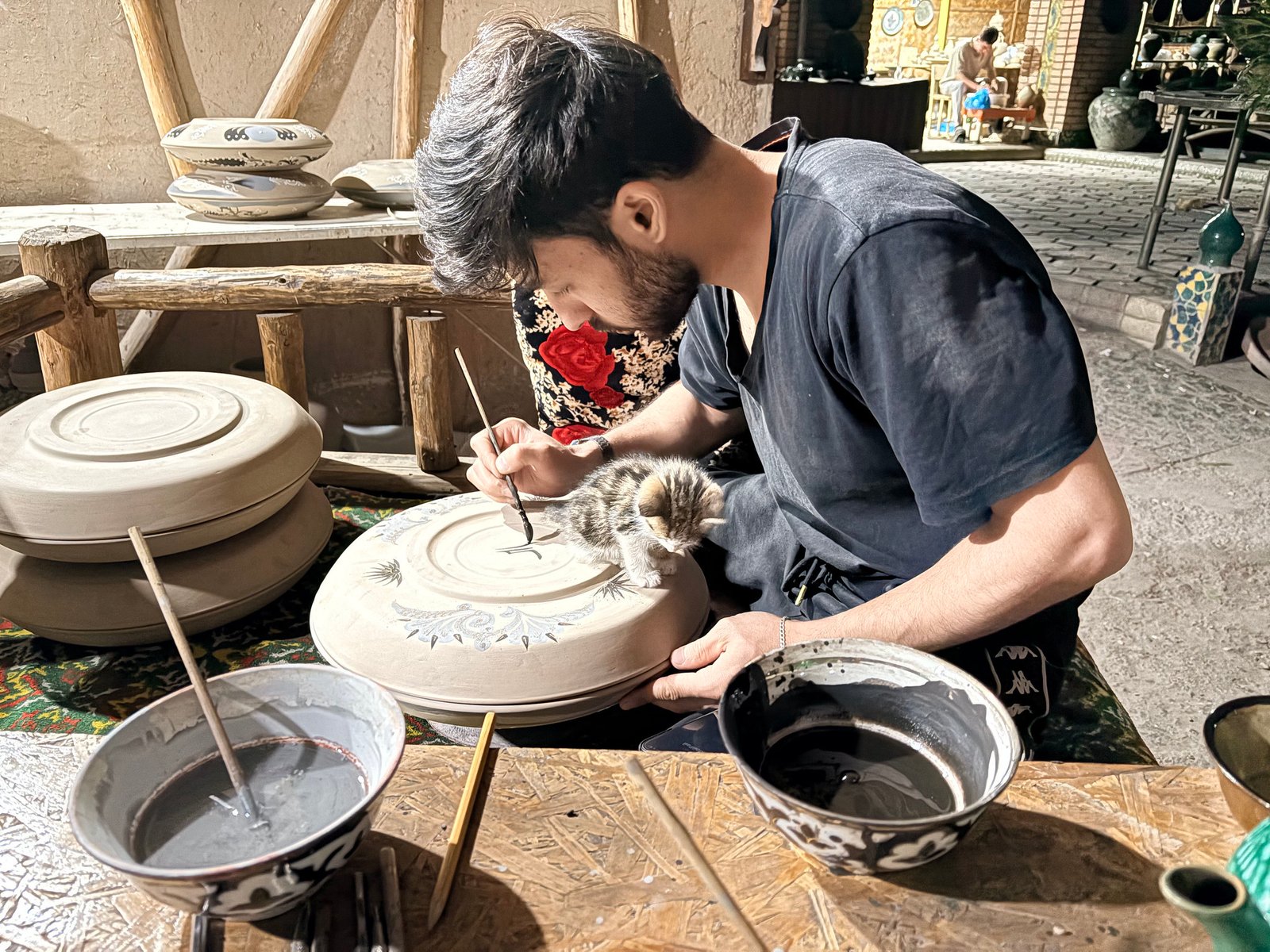
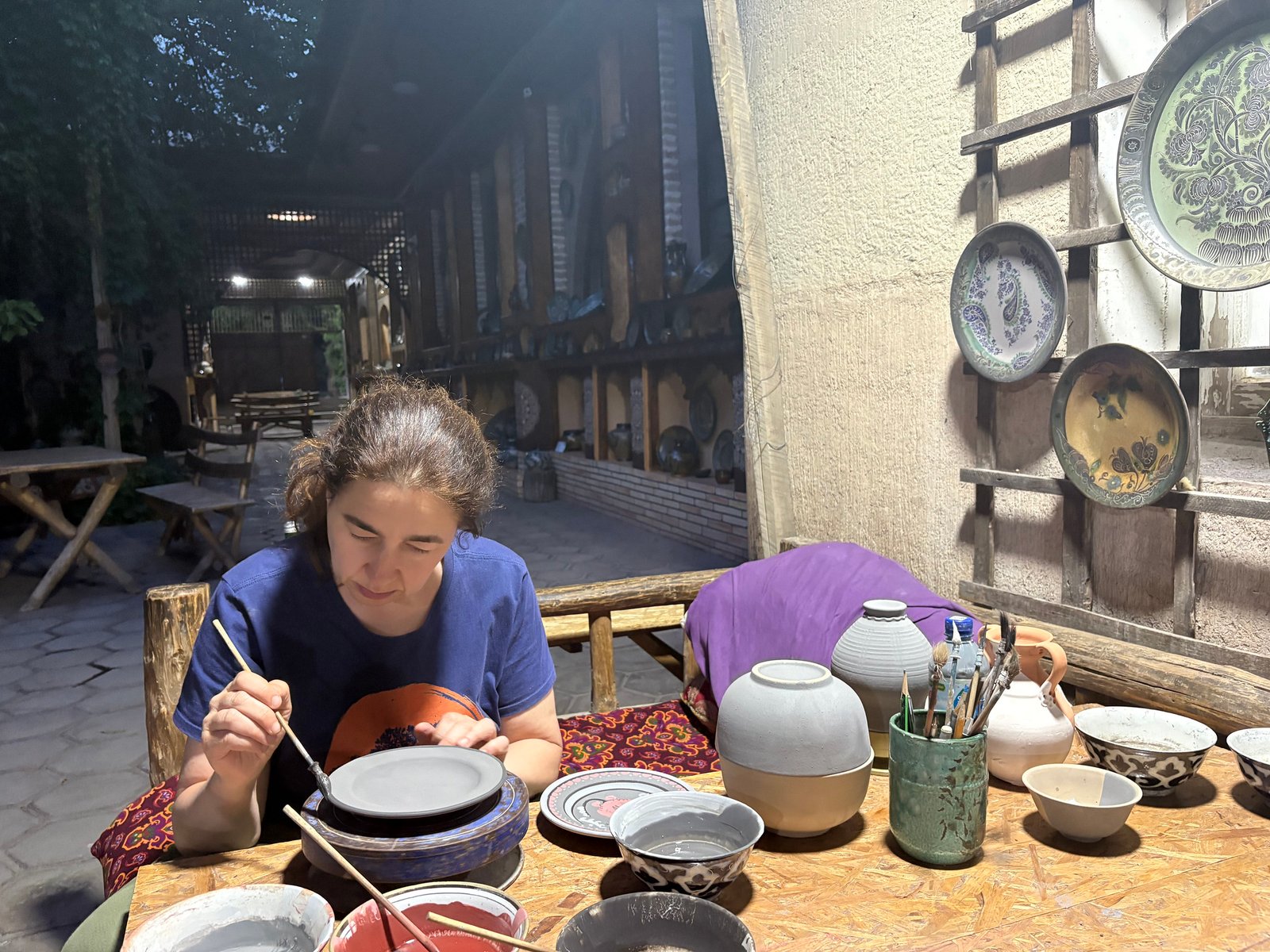
He was a gifted painter, creating intricate designs freehand onto the pottery, without sketches, pencil marks, or guides of any kind. It was mesmerizing to watch.
I admitted that I had never spent much time decorating my pottery. Instead, I usually dipped or sprayed on glaze, letting its natural beauty make up for my lack of painting skills.
"Today, you learn," he said simply, handing me a handful of brushes.
I spent the evening trying to recreate his designs. Attempting to wield the unfamiliar brushes, I felt clumsy, like a child finger-painting for the first time. When he came over to inspect my work, I apologized for my pitiful attempt at traditional Uzbek patterns.
"You will never paint like me," he said. "You don't have my background, my traditions, or my experiences. You have to learn to paint like yourself."
"I wish I had at least learned the basics before coming here," I admitted. "I'm always afraid to spend too much time decorating a piece."
He looked at me, puzzled.
"Pottery can fail at any moment," I explained. "A piece can collapse on the wheel, warp during trimming, get ruined while glazing, or explode in the kiln. I try not to get attached to any single piece. I also try not to spend too much time on one, because it hurts a lot less if it gets destroyed later."
Khamidulo studied me for a moment.
"I bet that doesn't happen very often here," I said. "This is a professional studio. It happens to me all the time."
"Come."
He led me to a dark corner of the workshop beside the bathrooms and pulled a dirty burlap cloth off a wheelbarrow.
I gasped.
The tray was filled with dozens of warped and broken plates, bowls, and vases. Some had only minor flaws, a blister in the glaze or a slight warp. Others were shattered beyond recognition. I crouched down for a closer look. Every single piece had been painstakingly decorated, carved, painted, and glazed. Intricate patterns still shimmered across cracked surfaces and twisted rims.
"Such a shame," I said quietly.
"Such is life," Khamidulo replied. "A kiln shelf collapsed during firing. Most of the pieces were lost."
He shrugged.
"We learn and move on. Those hours were not wasted. The final product is not always the piece of pottery you sell, but always the skill you gain while making it."
I felt my throat tighten. I had spent years producing "pottery for pets," always judging my successes by the number of functional pieces produced rather than by the quality of the final products. It was time to change my whole process.
I walked over to the table where Victor was camped out with his laptop and a pot of green tea. He had been reworking our itinerary, trying to change our five-day stay in Rishton to a whole week.
"I think I got it!" he said. "We'll be able to stay a week."
"That's great," I said. "But I am going to need a month...”

What a fun read, thanks for sharing !
We’re glad you liked it. There are more coming.