WARNING! This is a rant post.
Travelling through Europe this summer, we couldn’t help but notice one incredibly annoying trend. No, not mass tourism. And no, not TikTok influencers filming travel content everywhere.
Global travel has a new menace: AI slop.
No longer limited to social media and online, AI-generated graphics have now spilled onto the streets of travel destinations you’ve dreamed of visiting. Store signs, advertisements, and even souvenirs—Europe is oversaturated with AI junk right now. These generic AI-created images are cheap and tacky and, without doubt, rob travel destinations of their uniqueness and originality.
Let’s look at Hungary, for example.
Budapest’s premier shopping street, Vaci Utca, and Budapest Central Market were flooded with mediocre AI-generated images this summer. No matter where we looked, all we saw was the AI-manufactured junk.
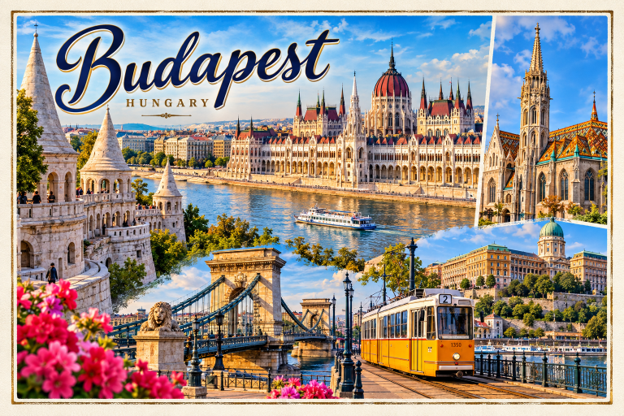
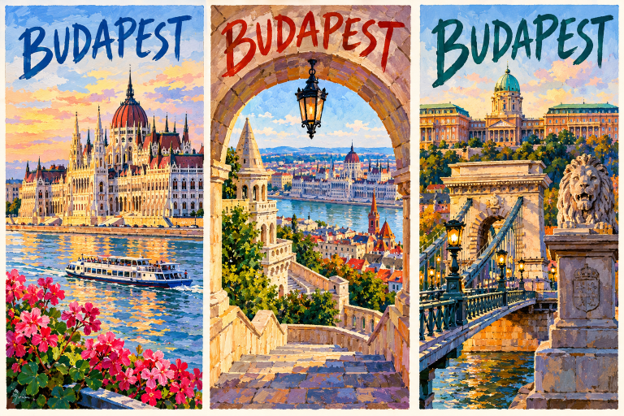
In one shop on Vaci Utca, we found a postcard stand where instead of beautiful shots of Budapest captured by local photographers, it was all AI slop. The postcards were low-quality and tasteless. Nothing original or unique about them. But the shocking part was that people were actually buying these awful postcards!! AI-generated postcards of Budapest!! I wanted to grab and shake these tourists: YOU CAN MAKE THE SAME POSTCARDS USING CHATGPT!!
The annoying part was that, like with everything AI produces, these images had numerous errors and inaccuracies. In one souvenir store, we found a cutting board with images of Hungarian national dishes. The images were clearly AI-generated, as was everything on sale in that store. And the cutting board had a big glaring mistake. Hungarian donuts looked nothing like Hungarian donuts. Hungarian donuts are solid. No holes. But the donuts on the cutting board had holes in the middle, clearly looking like American donuts.
And there were many other blunders: Hungarian paprika depicted as chili peppers from Mexico; Budapest Parliament on the wrong side of the Danube, etc. Our visit to Central Market turned into a contest to see who could find more AI-generated errors in souvenirs.
Outside of Budapest, things were not better. In southern Hungary near the Croatian border, as we strolled through the streets of Pecs, we noticed even more AI slop. At one outdoor café, tables had printed menus, and the images were clearly AI-generated. The menus had the dish names, and the ingredients for each dish were listed. Yet the ingredients were the same. For all the dishes. Worse, they were not even listings of the same ingredients but some Latin gibberish (“lorem ipsum dolor sit amet consetetur sadimseing elitr sed diam”). The pseudo-Latin placeholder text was probably used to demonstrate how the text would look on a page, but the café owners printed the menus anyway. Ugh...
One may say that the availability of AI-generated graphics is a good thing. Small store owners and mom-and-pop shops can now easily create store signs and menus without spending a fortune. Doing business becomes cheaper, and consumers win in the end. But the problem is that for now, these AI-generated images are ubiquitous, and it’s so off-putting to see them everywhere. In Bratislava, we stopped for lunch at a nice restaurant that, for some reason, had a tacky ChatGPT-made banner slapped next to the entrance door. Inside, the restaurant looked like a posh Viennese coffeehouse, but the ChatGPT banner at the entrance cheapened the ambiance.
Also, any potential benefits of AI, like making it easier to create store signs, are outweighed by threats to local culture. At this rate, AI may very well erase the visual distinctions between countries and regions, replacing their unique aesthetics with cheap, mass-produced imagery.
In Georgia—another country that we visited this summer—AI-generated images were also everywhere: store signs, billboards, advertisements. Some signs looked nearly identical to what we saw in Budapest and other Hungarian towns. If it wasn’t for the unique Georgian alphabet that was occasionally used, it would be nearly impossible to tell the difference. The way AI generated the images of Georgian khachapuri or Hungarian chimney cake, there was not much of an aesthetic difference. It looked like everything was made in the same printing shop. I would rather see handwritten signs on a chalkboard or even fewer signs altogether than this cheap, mass-produced stuff.
It will be interesting to see where it will take us. Once the AI euphoria subsides, the next trend might be returning to square one and not using AI at all. Realizing how unoriginal, cheap, and tacky your business looks may potentially cause people to reverse course. Already, some businesses are going this route. But it’s also very possible that things will get even worse. As with all predictions, only time will tell.
Rant over. Thank you for listening.
But while we are here, feel free to buy the Budapest postcards I made using ChatGPT: